




Original Article - Year 2026 - Volume 41Issue 1
Who Shaped the Brazilian Journal of Plastic Surgery? A 40-Year Retrospective
Quem moldou a Revista Brasileira de Cirurgia Plástica? Uma retrospectiva de 40 anos

ABSTRACT
Introduction Materials and
Methods We conducted a descriptive and retrospective study analyzing the articles published in BJPS. The inclusion criterion was all articles published and accessible on the journal's website, spanning from volume 12, issue 1 (1997), to volume 39, issue 3 (2024). The following article types were considered: "original article," "special article," "review article," "case report," "letter to the editor," "editorial" and "ideas and innovation."
Results A total of 2,706 published articles were analyzed. A ranking of the top 25 authors, among the 4,827 contributors identified, was developed, along with their respective institutions. The largest coauthorship communities were mapped.
Conclusion By mapping its key contributors and research networks, the present study offers a comprehensive bibliometric analysis of the BJPS.
Keywords: historical article; authorship in scientific publication; databases; bibliographic; data science; festschrift
RESUMO
Introdução A Revista Brasileira de Cirurgia Plástica (RBCP) é a publicação oficial da Sociedade Brasileira de Cirurgia Plástica, que celebra 40 anos de existência em 2025. Ao longo de sua história, somente um número limitado de estudos analisou o conteúdo publicado pelo periódico. O objetivo deste estudo é realizar uma análise abrangente de todas os artigos acessíveis no website da RBCP.
Materiais e Métodos Foi realizado um estudo descritivo e retrospectivo, em que foram analisados os artigos publicados na RBCP. O critério de inclusão foi todos os artigos publicados e acessíveis no website do periódico entre o volume 12, número 1 (1997), e o volume 39, número 3 (2024). O estudo considerou os seguintes tipos de artigo: "artigo original," "artigo especial, "artigo de revisão," "relato de caso," "carta ao editor," "editorial" e "ideias e inovações."
Resultados Foram analisados 2.706 artigos publicados. Foi estabelecido um ranking dos 25 principais autores entre os 4.827 colaboradores identificados, juntamente com suas respectivas instituições. As maiores comunidades de coautoria foram mapeadas.
Conclusão Ao mapear seus principais colaboradores e redes de pesquisa, este estudo oferece uma análise bibliométrica abrangente da RBCP.
Palavras-chave: artigo histórico; autoria na publicação científica; bases de dados bibliográficas; ciência de dados; publicação comemorativa
Introduction
The Brazilian Journal of Plastic Surgery (BJPS) is the official scientific publication of the Brazilian Society of Plastic Surgery (Sociedade Brasileira de Cirurgia Plástica, in Portuguese), which has been published continuously since 1986 and celebrates its 40th anniversary in 2025.1 It is dedicated to the dissemination of research findings and advancements in plastic and reconstructive surgery, serving as a platform for the exchange of scientific knowledge and innovation in the field.2 Published quarterly, BJPS includes original articles, case reports, systematic reviews, and surgical innovations, fostering continuous education for specialists in Brazil and beyond. With a focus on high-quality scientific content,3 it serves as a key platform for knowledge exchange among surgeons, researchers, and healthcare professionals, reinforcing Brazil’s influence in the global plastic surgery community. Throughout its history, few articles4 have analyzed the content published by the journal.
Assessing a journal’s evolution through key milestones is a well-established practice in bibliometric research.5 Bibliometrics examines quantitative indicators of scientific output, which can include number of publications, citation impact, and collaboration networks. These metrics facilitate a systematic comparison of the impact of authors within the scientific community.6 Some examples of general bibliometric trends in plastic surgery and other fields can be referenced. The Plastic and Reconstructive Surgery journal was the subject of an analysis of its 75-year history,7 highlighting how evidence-based medicine has revolutionized the field. In another study,8 the evolution in publication trends in plastic surgery was analyzed from 1980 to 2010, focusing on changes in research topics, authorship patterns, and citation impact. A longitudinal bibliometric approach was employed to examine the scientific output and collaborative networks within the field; the findings provide insights into the progression of scholarly contributions and the influence of emerging innovations in plastic surgery research.8 The BJPS itself was the topic of a study on publication trends from 2010 to 2019, which analyzed authorship patterns, research themes, and citation impact. A bibliometric approach was employed to assess the evolution of scientific contributions and the journal’s role in disseminating plastic surgery advancements.4Likewise, thecentury-longtrajectory of Anais Brasileiros de Dermatologia was analyzed,5 identifying its most influential contributors and mapping coauthorship networks. Using bibliometric and scientometric approaches, the study examined authorship patterns, collaboration dynamics, and scholarly impact; the findings offer insights into the journal’s evolution and its role in dermatological research.5 Finally, the Aesthetic Plastic Surgery Journal was the subject of a bibliometric analysis of articles published from 1976 to 2023,9 focusing on publication trends, author productivity, and citation patterns.
Building upon previous bibliometric research in plastic surgery, the current study aims to provide a comprehensive analysis of BJPS’s four-decade trajectory. By identifying its most influential contributors and mapping coauthorship networks, the study seeks to offer insights into the journal’s scientific impact and collaborative landscape.
Materials and Methods
The present is an applied, descriptive, and quantitative study. It used a documentary procedure conducted on the official web site of the BJPS. This section outlines the methodological approach, detailing the data collection process, data preprocessing, and computation of author-related metrics.
Data Collection
Data collection was conducted using web scraping, a technique that enables the automated extraction of information from web sites.10 To facilitate this process, a custom scraper was developed to retrieve data from all available editions of the BJPS journal (https://www.rbcp.org.br/). The scraper was executed on February 23, 2025, at 10 a.m., capturing a complete snapshot of the journal’s publicly-accessible data at that time. The dataset spans 28 years of publication history, encompassing issues from volume 12, issue 1 (1997), to volume 39, issue 3 (2024). This procedure resulted in the retrieval of 2,706 contributions, including original articles, special articles, review articles, case reports, letters to the editor, editorials, and articles on ideas and innovations. Due to the unavailability of volumes 1 to 11 on the journal’s web site, these publications were not included in the analysis, resulting in a limitation regarding the study’s temporal coverage.
Data Preprocessing
Following data acquisition, preprocessing was performed to extract author names, identifying 11,292 unique entries. A major challenge in bibliometric analysis is name ambiguity, which can result from variations in formatting, inconsistent use of initials, or name changes over time. To enhance accuracy, the Levenshtein distance algorithm was applied to detect and consolidate name variations. This process revealed multiple discrepancies, such as Dov Charles Goldenberg, whose name appeared in various formats (such as “Dov Goldenberg”, “Dov C Goldenberg”, and “Charles Goldenberg”). After standardization, the total number of distinct authors was reduced to 4,827, improving the reliability of author-based metrics. Similar name disambiguation approaches have been successfully employed in bibliometric research, contributing to more accurate assessments of author impact and collaborative networks.5,11 The institutional affiliation of each author was determined based on three prioritized sources, as follows: 1) the Editorial Board page of BJPS; 2) the author’s most recent publication; and 3) the database of the Lattes platform, of Conselho Nacional de Desenvolvimento Científico e Tecnológico (CnPq, the Brazilian National Council for Scientific and Technological Development). In cases in which multiple affiliations were associated with the same author, preference was given to the affiliation to a higher-education institution.
Computing Authors Metrics
The collaboration network graph was developed, and author metrics were computed using Gephi (open source; https://gephi.org/), a specialized tool for social network analysis (SNA).12 Graph theory plays a fundamental role in SNA, providing an abstract framework to represent authors (nodes) and their coauthorships (edges). The graph represents the overall coauthorship structure, capturing scientific collaboration patterns within the journal history. Each edge has a weight which quantifies the frequency of collaboration among coauthors, and a higher weight indicates repeated joint publications. The graph is classified as undirected, as author order in publications was not taken into account.
The current study applies graph theory, which serves as the theoretical foundation for SNA, to evaluate authorial influence and collaboration patterns within the journal. The following indicators were computed:
Number of publications (Pub): represents the total count of publications in which an author has contributed, irrespective of their position among coauthors. This metric provides an overview of an author’s scientific productivity.
Degree (Deg): measures the number of distinct coauthors with whom an individual has collaborated. This metric is crucial in coauthorship networks, as it reveals collaborative behavior and connectivity patterns within the academic community. Authors with high-degree centrality function as key hubs, facilitating the exchange of knowledge, research ideas, and interdisciplinary collaborations. Such individuals often exert significant influence over the dissemination of scientific advancements within their field.13
Betweenness centrality (BC): quantifies an author’s role as a bridge between distinct research groups, highlighting their influence in knowledge dissemination and interdisciplinary collaboration.14
PageRank (PR): originally developed by Google (Alphabet Inc.), PageRank determines the importance of web pages based on their linkage structure. More recently, it has been applied in scientific citation networks to identify high-impact researchers. In the present study, PR was used to detect authors who hold leadership positions within the BJPS research community, signifying their prominence in scholarly interactions.15,16
Community detection (Com): coauthorship communities were identified using the Louvain algorithm, a widelyemployed method to detect clusters within networks.17 The community ranking is based on size, in which Community 1 represents the largest, followed by Community 2, and so forth. This classification enables the identification of collaborative subgroups, highlighting research concentration areas, same institutional affiliations, or interdisciplinary connections within the journal’s academic network.
By leveraging network analysis, this approach facilitates the identification of key opinion leaders, highly-collaborative researchers, and structural trends within the journal’s academic community.14
Results
Table 1 lists authors with more than 25 publications in BJPS, identifying the journal’s most prolific contributors. This criterion enabled the identification of the top 25 most prolific authors, representing 0.51% of the journal’s 4,827 contributors. Collectively, these authors account for 1,102 publications out of the 2,706 articles published in BJPS and publicly available up to its 39th volume, underscoring their significant contribution to the journal.
| Rank | Author | Pub | Deg | BC | PR | Com | Institution |
|---|---|---|---|---|---|---|---|
| 1 | Marcus Castro Ferreira | 115 | 173 | 0.072815 | 0.005929 | 1 | USP |
| 2 | Lydia Masako Ferreira | 103 | 214 | 0.195687 | 0.006541 | 2 | UNIFESP |
| 3 | Dov Charles Goldenberg | 89 | 49 | 0.018001 | 0.001315 | 1 | USP |
| 4 | Jose Carlos Daher | 55 | 58 | 0.005578 | 0.001560 | 18 | Hospital Daher |
| 5 | Salustiano Gomes de Pinho Pessoa | 51 | 49 | 0.028646 | 0.002062 | 8 | UFC |
| 6 | Rolf Gemperli | 50 | 111 | 0.029867 | 0.002693 | 1 | USP |
| 7 | Renato da Silva Freitas | 47 | 94 | 0.104108 | 0.002686 | 5 | UFPR |
| 8 | Pedro Bins Ely | 41 | 49 | 0.007023 | 0.001727 | 7 | UFCSPA |
| 9 | Marcela Caetano Cammarota | 40 | 55 | 0.023113 | 0.001148 | 18 | Hospital Daher |
| 10 | Claudio Cardoso de Castro | 39 | 42 | 0.039580 | 0.001382 | 3 | UERJ |
| 11 | Aymar Edison Sperli | 39 | 24 | 0.005262 | 0.001157 | 2 | FCMSCSP |
| 12 | Jorge Bins Ely | 38 | 49 | 0.003598 | 0.001609 | 16 | UFSC |
| 13 | Katia Torres Batista | 38 | 39 | 0.014414 | 0.001694 | 13 | Rede SARAH |
| 14 | Antonio Roberto Bozola | 37 | 59 | 0.014985 | 0.002028 | 22 | FAMERP |
| 15 | Ricardo Baroudi | 34 | 29 | 0.030129 | 0.000953 | 1 | PUC-SP |
| 16 | Fabio Xerfan Nahas | 32 | 50 | 0.028834 | 0.001632 | 2 | USP |
| 17 | Ivo Pitanguy | 30 | 72 | 0.041094 | 0.002299 | 12 | PUC-Rio |
| 18 | Jefferson Lessa Soares de Macedo | 30 | 53 | 0.020018 | 0.001740 | 13 | FEPECS |
| 19 | Milton Paulo de Oliveira | 30 | 39 | 0.003724 | 0.001441 | 11 | PUCRS |
| 20 | Osvaldo Ribeiro Saldanha | 29 | 94 | 0.043816 | 0.002555 | 4 | UNIMES |
| 21 | Hugo Alberto Nakamoto | 29 | 45 | 0.005031 | 0.001314 | 1 | USP |
| 22 | Ewaldo Bolivar de Souza Pinto | 27 | 72 | 0.011139 | 0.001981 | 4 | UNISANTA |
| 23 | Evaldo A. D Assumpção | 27 | 10 | 0.037816 | 0.000274 | 7 | PUC Minas |
| 24 | Diogo Franco | 26 | 43 | 0.032639 | 0.001620 | 17 | UFRJ |
| 25 | Marcos Ricardo de Oliveira Jaeger | 26 | 39 | 0.003876 | 0.001226 | 11 | PUCRS |
Abbreviations: BC, betweenness centrality; Com, community detection; Deg, degree; FAMERP, Faculdade de Medicina de São José do Rio Preto; FCMSCSP, Faculdade de Ciências Médicas da Santa Casa de São Paulo; FEPECS, Fundação de Ensino e Pesquisa em Ciências da Saúde; PR, PageRank; Pub, number of publications; PUC Minas, Pontifícia Universidade Católica de Minas Gerais; PUC-Rio, Pontifícia Universidade Católica do Rio de Janeiro; PUCRS, Pontifícia Universidade Católica do Rio Grande do Sul; PUC-SP, Pontifícia Universidade Católica de São Paulo; UERJ, Universidade do Estado do Rio de Janeiro; UFC, Universidade Federal do Ceará; UFCSPA, Universidade Federal de Ciências da Saúde de Porto Alegre; UFPR, Universidade Federal do Paraná; UFSC, Universidade Federal de Santa Catarina; UNIFESP, Universidade Federal de São Paulo; UNIMES, Universidade Metropolitana de Santos; UNISANTA, Universidade Santa Cecília; USP, Universidade de São Paulo.

The table ranks authors in descending order based on their publication count, while also presenting their Deg, BC, and PR scores, which reflect their prominence within the coauthorship network. Beyond the top 25, we identified an additional 22 authors with at least 20 publications, 106 authors with 10 to 19 publications, 322 authors with 5 to 9 publications, 1,233 authors with 2 to 4 publications, and 3,119 authors who contributed to a single article. Notably, 64.61% of BJPS’s authors published only once, reflecting a high proportion of one-time contributors.
The five highest-ranking authors were identified for each key metric: Pub, Deg, BC, and PR. Based on Pub, the 5 most prolific contributors to BJPS history were identified as follows: Marcus Castro Ferreira (rank = 1), who authored 115 publications, followed by Lydia Masako Ferreira (rank = 2), with 103, Dov Charles Goldenberg (rank = 3), reaching 89, Jose Carlos Daher (rank = 4), totaling 55, and Salustiano Gomes de Pinho Pessoa (rank = 5), contributing 51 times. These 5 authors contributed 413 publications, accounting for more than 15% of the journal’s total publications throughout the period analyzed. The top 25 ranked authors presented a mean Pub of 44.08 ± 23.68, reflecting a highlyprolific subgroup. In contrast, the overall mean Pub per author was significantly lower, at 2.34 ± 4.35. This pronounced discrepancy highlights the dominance of a small subset of highly-prolific authors in shaping BJPS’s publication landscape.
In terms of Deg, which is a measure of an author’s collaborative reach based on the number of unique coauthors, the highest values were observed for Lydia Masako Ferreira (rank = 2), with 214 coauthors, Marcus Castro Ferreira (rank = 1), with 173, Rolf Gemperli (rank = 6), with 111, Renato da Silva Freitas (rank = 7), with 111, and Osvaldo Ribeiro Saldanha Junior (rank = 20), who also collaborated with 111 coauthors. The top 25 ranked authors had an average of 64.44 ± 45.08 coauthors, which is substantially higher than the overall mean of 7.1 ± 7.76. This contrast underscores the substantially-larger collaborative networks of the most prolific authors compared with the general author population.
Authors with the highest BC scores played a key role in connecting distinct research communities within BJPS. Notable contributors in this metric include Lydia Masako Ferreira (rank = 2), Renato da Silva Freitas (rank = 7), Marcus Castro Ferreira (rank = 1), Nivaldo Alonso (rank = 26; Pub = 25; Deg = 63; and BC = 0,046047), and Osvaldo Ribeiro Saldanha (rank = 20). Despite not being ranked among the top 25 authors, Nivaldo Alonso’s high BC score reflects his extensive collaborations across multiple research communities. The mean PR among the top 25 ranked authors was of 0.032832 ± 0.041129, which is significantly higher than the overall mean of 0.000654 ± 0.004341.
The highest PR values identify authors who hold a prominent position within BJPS, likely due to their influential roles in mentoring emerging researchers in the field. In this metric, the most notable authors include Lydia Masako Ferreira (rank = 2), Marcus Castro Ferreira (rank = 1), Rolf Gemperli (rank = 6), Renato da Silva Freitas (rank = 7), and Osvaldo Ribeiro Saldanha (rank = 20). The mean PR among the top 25 ranked authors was of 0.002023 ± 001384, whereas the mean PR across all authors was substantially lower, of 0.000207 ± 0.000218. In this context, PR quantifies the influence of authors within the BJPS research network. It is based on the principle that an author’s importance increases the more frequently they participate as coauthors in publications by other influential researchers. This underscores the influence of these researchers, as their collaborations enhance the visibility and reach of other authors within the BJPS network.
Fig. 1 presents the top 25 ranked authors, their collaborations, and research communities. The larger the node, the greater the number of publications by the author. The thickness of the link represents the frequency of coauthorships. Different node colors indicate distinct coauthorship communities.
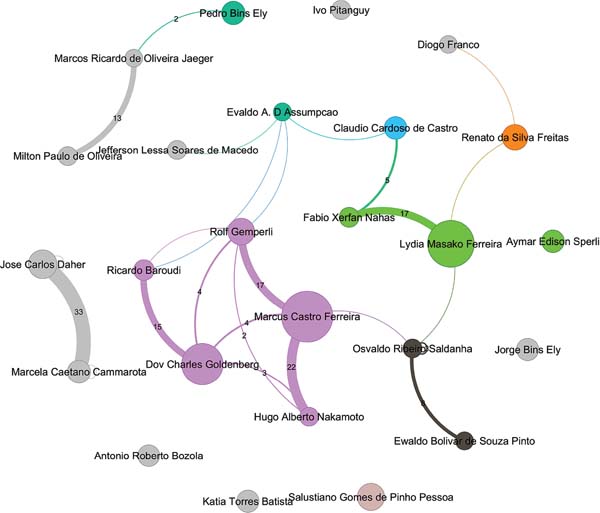
The largest coauthorship community, depicted in lavender in ►Fig. 1, comprises 339 members who are primarily associated with Universidade de São Paulo (USP). This group includes 5 of the top-ranked authors, with Marcus Castro Ferreira (rank = 1) and Dov Charles Goldenberg (rank = 3) as its leading contributors. Representing 6.3% of all BJPS authors and 20% of those in the top 25 ranking, this community plays a significant role in the journal’s history. The second-largest coauthorship community, represented in green, consists of 265 authors and has 3 top-ranked authors, primarily affiliated with the Universidade Federal de São Paulo (UNIFESP). This group is led by Lydia Masako Ferreira (rank = 2). The third-largest coauthorship community, depicted in blue, comprises 187 members and is led by Claudio Cardoso de Castro (rank = 10), from Universidade do Estado do Rio de Janeiro (UERJ). Notably, he is the only author from this group to appear in the top 25 ranking. The fourth-largest coauthorship community, represented in dark gray, comprises 180 members and is led by 2 top-ranked authors: Osvaldo Ribeiro Saldanha (rank = 20) from Universidade Metropolitana de Santos (UNIMES), and Ewaldo Bolivar de Souza Pinto (rank = 22) from Universidade Santa Cecília (UNISANTA). Both institutions are located in the city of Santos, state of São Paulo, highlighting a regional academic collaboration. It is noteworthy that Osvaldo Ribeiro Saldanha has also established collaborations with leading authors from the USP and UNIFESP communities, strengthening interinstitutional academic networks. By bridging research networks from USP and UNIFESP, these collaborations enhance his BC and PR metrics, reinforcing his role as a key connector in BJPS’s coauthorship structure.
The fifth-largest coauthorship community, represented in orange, consists of 172 members and is led by Renato da Silva Freitas (rank = 7), from Universidade Federal do Paraná (UFPR), who is notably its only representative among the top-ranked authors. The sixth-largest community, with 171 members, is the largest to not feature any top-ranked authors, suggesting a more decentralized or emerging research network. The seventh-largest community, depicted in sea green, consists of 167 members and includes 2 ranked authors: Pedro Bins Ely (rank = 8), from Universidade Federal de Ciências da Saúde de Porto Alegre (UFCSPA), and Evaldo A. D’Assumpção (rank = 23), from Pontifícia Universidade Católica de Minas Gerais (PUC Minas). The eighth-largest community, represented in brown, has 161 members and is distinguished by the presence of Salustiano Gomes de Pinho Pessoa (rank = 5), from Universidade Federal do Ceará (UFC) among the top-ranked authors. Together, these communities further expand BJPS’s collaborative landscape, with varying degrees of influence from top-ranked authors. These 8 largest communities encompass 1,642 authors, representing 34% of the journal’s authors.
Fig. 1 also illustrates coauthorship networks among authors. The most frequent collaboration was observed between José Carlos Daher and Marcela Caetano Cammarota, with 33 coauthored publications. The second most frequent collaboration, occurring 24 times, was between Diogo Franco and Talita Franco (rank = 29; Pub = 25); however, this partnership is not depicted as the latter is not among the topranked authors. The third most frequent collaboration involved Marcus Castro Ferreira and Hugo Alberto Nakamoto, with 22 coauthored publications.
Conclusion
The current study examines the publication history of BJPS by analyzing all volumes and their respective publications available on the journal’s web site. A total of 2,706 contributions were identified, authored by 4,827 distinct contributors. A ranking of the top 25 authors was developed based on key bibliometric indicators, including Pub, Deg, BC, and PR.
The findings reveal that Marcus Castro Ferreira is the most prolific author in terms of Pub, while Lydia Masako Ferreira emerges as the most influential contributor according to the other metrics. Additionally, Dov Charles Goldenberg, José Carlos Daher, and Salustiano Gomes de Pinho Pessoa are noteworthy for their publication output, whereas Rolf Gemperli, Renato da Silva Freitas, and Osvaldo Ribeiro Saldanha hold significant positions in terms of network influence. Furthermore, 64.61% of all authors have contributed only 1 article to the journal. The study also maps the main coauthorship communities, detailing their size, key members, and institutional affiliations.
These results provide a comprehensive overview of BJPS’s scientific contributions, highlighting the individuals and collaborative networks that have played a central role in shaping the journal’s history, leading up to its fortieth anniversary.
References
1. Goldenberg D, Baroudi R. New rules for the Brazilian Journal of Plastic Surgery - BJPS. Rev Bras Cir Plást 2015;30(01):1. Doi: 10.5935/2177-1235.2015RBCP0108
2. Denadai R, Goldenberg D, Raposo-do-Amaral CE. Bibliometric analysis of articles published in the Brazilian Journal of Plastic Surgery between 2005 and 2012. Part I: quantitative analysis of articles, authors, and geographical distribution. Rev Bras Cir Plást 2014;29(01):2-9. Doi: 10.5935/2177-1235.2014RBCP0002
3. Goldenberg D. Final steps for indexing. Rev Bras Cir Plást 2024;39 (01):e03901. Doi: 10.5935/2177-1235.2024RBCP.edit.v39n1-EN
4. Secanho MS, Silva ID, Chequim MM, et al. Brazilian Journal of Plastic Surgery: analysis of articles published between 2010- 2019. Rev Bras Cir Plást 2021;36(04):374-381. Doi: 10.5935/2177-1235.2021RBCP0121
5. Grimaldi HC, Camargo SdS. Anais Brasileiros de Dermatologia: who wrote this century-old history? An Bras Dermatol 2025;100 (3):527-538 Doi: 10.1016/j.abd.2025.02.001
6. Goldenberg D. Scientometrics and its positive consequences. Rev Bras Cir Plást 2017;32(04):471. Doi: 10.5935/2177-1235.2017RBCP0077
7. Thoma A, Eaves FF III, Murphy J, Coroneos CJ, Voineskos SH, Rohrich RJ. Seventy-Fifth Anniversary of Plastic and Reconstructive Surgery: How Evidence-Based Medicine Has Transformed Plastic Surgery. Plast Reconstr Surg 2021;147(05):1235-1241. Doi: 10.1097/PRS.0000000000007913
8. Spake CSL, Zeyl VG, Crozier JW, Rao V, Kalliainen LK. An analysis of publication trajectory in plastic surgery across the decades. J Plast Reconstr Aesthet Surg 2022;75(01):439-488. Doi: 10.1016/j. bjps.2021.09.039
9. Bai L, Chen K. A Bibliometric Analysis of the Articles Published in the Aesthetic Plastic Surgery Journal (1976-2023). Aesthetic Plast Surg 2025;49(06):1784-1796. Doi: 10.1007/s00266-024-04456-6
10. Rodman O. Mastering Web Scraping: Unveiling the Secrets of Data Extraction. S.n.:s.l.; 2023
11. Camargo SdS, Grimaldi HC. 65 Anos dos Arquivos Catarinenses de Medicina: Quem Escreveu esta História? Arq Catarin Med 2023; 52(04):14-29. Doi: 10.63845/ep1gpp17
12. Gross JL, Yellen J. Graph Theory and Its Applications. 3rd ed. New York: Chapman and Hall/CRC; 2023. Doi: 10.1201/ 9780429425134
13. Bailie J, Matous P, Bailie R, Passey ME. Patterns of collaboration and knowledge generated by an Australian rural research centre over 20 years: a co-authorship network analysis. Health Res Policy Syst 2023;21(01):87. Doi: 10.1186/s12961-023-01029-y
14. Chartier C, Lee JC, Borschel G, Chandawarkar A. Using Big Data to Assess Legitimacy of Plastic Surgery Information on Social Media. Aesthet Surg J 2022;42(01):NP38-NP40. Doi: 10.1093/asj/sjab253
15. Zhu W, Jin C, Ma Y, Xu C. Earlier recognition of scientific excellence enhances future achievements and promotes persistence. J Informetrics 2023;17(02101408 . Doi: 10.1016/j.joi.2023.101408
16. Han L, Zang S, Zhao Y. A method of evaluation index of author’s academic influence based on author Citation Network. In: 14th International Conference on Intelligent Human-Machine Systems and Cybernetics (IHMSC); 2022; Hangzhou; IEEE; 2022:72-75. Doi: 10.1109/IHMSC55436.2022.00026
17. Zuin G, Lomeu H, Barros G, et al. A Modified Louvain Approach for Medical Community Detection using Geographic Data. In: 36th International Symposium on Computer-Based Medical Systems (CBMS); 2023; L’Aquila, Italy; IEEE; 2023:143-148. . Doi: 10.1109/ CBMS58004.2023.00206
1. Post-Graduation Program in Applied Computing, Universidade Federal do Pampa, Bagé,
RS, Brazil
2. Private practice, Bagé, RS, Brazil
Address for correspondence Sandro da Silva Camargo, Programa de Pós-Graduação em Computação Aplicada, Universidade Federal do Pampa, Bagé, RS, 96413-172, Brazil (e-mail: sandrocamargo@unipampa.edu.br).
Artigo submetido: 28/03/2025.
Artigo aceito: 22/07/2025.
Conflict of Interests
The authors have no conflict of interest to declare.
 Read in Portuguese
 Read in English
 PDF PT
 Print
Print
 Send this article by email
 How to Cite
 Mendeley
 Pocket
 Facebook
 Twitter