




Original Article - Year 2026 - Volume 41Issue 1
Methodology for the Guidelines of the Brazilian Society of Plastic Surgery: Current Best Practices
Metodologia para as diretrizes da Sociedade Brasileira de Cirurgia Plástica: boas práticas atuais
Juan Carlos Montano Pedroso1, ; Marcelo Moura Costa Sampaio2; Ana Claudia Roxo3; Denis Calazans Loma2; Katia Torres Batista4; Marcelo Sacramento Cunha5; Pedro Soler Coltro6; Renato Da Silva Freitas7; Vívian Pacheco De Lemos8; Miguel Sabino1
ABSTRACT
Introduction Rapid guidelines are needed in scenarios that require timely recommendations, such as the emergence of new interventions or urgent demands for clinical guidance, situations that are common in plastic surgery. However, shortened timelines should not compromise methodological rigor or transparency. This study aimed to synthesize methodological recommendations for developing rapid guidelines.
Methods A narrative review of the literaturewas conducted based on methodological publications addressing rapid guideline development. Data were synthesized qualitatively and narratively, organizing findings according to the main stages of guideline development, from planning and scope definition to recommendation formulation, implementation, and updating.
Results The included studies provided methodological recommendations covering all stages of rapid guideline development, including scope definition, prioritization of structured questions, panel composition, evidence assessment and synthesis, formulation of recommendations, and planning for implementation and updating. Strategies to optimize the process included the use of existing guidelines, the GRADE-ADOLOPMENT model, prioritization of available systematic reviews, and application of structured frameworks such as GRADE, Summary of Findings (SoF), and Evidence to Decision (EtD). Key challenges included limited time, human resources, availability of evidence, and financial constraints.
Conclusion Rapid guidelines can be developedwith adequatemethodological quality when structured, transparent, and evidence-based processes are followed. The synthesis presentedmay serve as a practical guide for the development of rapid guidelines, particularly within the Brazilian Society of Plastic Surgery (Sociedade Brasileira de Cirurgia Plástica, SBCP, in Portuguese).
Keywords: guidelines as topic; practice guideline; health policy; consensus statement; guideline adherence; GRADE approach; systematic review
RESUMO
Introdução Diretrizes rápidas são necessárias em cenários que exigem recomendações oportunas, como o surgimento de novas intervenções ou demandas urgentes de orientação clínica, algo frequente na cirurgia plástica. Entretanto, a redução do tempo de desenvolvimento não deve comprometer o rigor metodológico nem a transparência do processo. Este estudo teve como objetivo sintetizar recomendações metodológicas para a elaboração de diretrizes rápidas.
Métodos Foi realizada uma revisão narrativa da literatura baseada em publicações metodológicas sobre desenvolvimento de diretrizes rápidas. A síntese dos dados foi conduzida de forma qualitativa e narrativa, organizando os achados de acordo com as diferentes etapas do processo de elaboração de diretrizes, desde o planejamento e definição do escopo até a formulação, implementação e atualização das recomendações.
Resultados A análise dos estudos identificou recomendações metodológicas para todas as etapas do desenvolvimento de diretrizes rápidas, incluindo definição do escopo, priorização de perguntas estruturadas, composição do painel, avaliação e síntese das evidências, formulação das recomendações e planejamento da implementação e atualização. Estratégias para otimizar o processo incluíram o uso de diretrizes previamente publicadas, aplicação do modelo de ADOLOPMENT, priorização de revisões sistemáticas existentes e utilização de frameworks estruturados, como GRADE, Summary of Findings (SoF) e Evidence to Decision (EtD). Entre os principais desafios, destacaram-se limitações de tempo, recursos humanos, disponibilidade de evidências e financiamento.
Conclusão Diretrizes rápidas podem ser desenvolvidas com qualidade metodológica adequada, desde que sejam utilizados processos estruturados, transparentes e baseados em evidências. A síntese apresentada pode servir como guia prático para a elaboração de diretrizes rápidas, especialmente no âmbito da Sociedade Brasileira de Cirurgia Plástica (SBCP).
Palavras-chave: guias como assunto; guia de prática clínica; política de saúde; declaração de consenso; fidelidade a diretrizes; abordagem GRADE; revisão sistemática
Introduction
Guidelines contain recommendations intended to inform users (e.g., healthcare professionals, the general public, or patients) about the benefits and harms of a specific intervention or clinical situation, with the goal of achieving the best possible health outcomes.
Guidelines vary according to their purpose, scope, and development timeline.
Traditional guidelines typically require approximately two years or more to develop due to the multiple steps involved, including the identification of important outcomes, evidence retrieval, evidence synthesis and presentation, peer review, dissemination and implementation, among others.1
However, certain situations require the development, dissemination, and implementation of guidelines within a shortened timeframe, such as public health emergencies, urgent humanitarian crises, the emergence of new treatment modalities, or the availability of new evidence regarding existing treatments.2 The emergence of relevant new evidence concerning the effectiveness, safety, or cost-effectiveness of a new or existing intervention is often considered the primary reason for developing rapid guidelines. Other justifications include the need to respond to public concerns or urgent requests for guidance from external stakeholders.3 Such situations are common in the field of plastic surgery.
Rapid guidelines (RGs) are guidelines developed using an abbreviated timeline. A major challenge in the development of rapid guidelines is maintaining methodological rigor while meeting shortened development deadlines.2 Importantly, guidelines developed within a shortened timeframe should not be regarded as inherently less trustworthy.3 This article presents a narrative review of these recommendations with the aim of providing a practical guide for use by the Brazilian Society of Plastic Surgery (Sociedade Brasileira de Cirurgia Plástica, SBCP, in Portuguese) in the development of clinical practice guidelines within the specialty.
Methods
This narrative review was conducted to synthesize the main methodological concepts related to the development of rapid guidelines and rapid systematic reviews. The review was conducted in accordance with recommendations for narrative reviews, including prior definition of the research question, a structured search strategy, predefined inclusion and exclusion criteria, and critical appraisal and narrative synthesis of the literature.4,5
This study was conducted in accordance with the ethical principles applicable to research involving human participants, fully adhering to the principles of the World Medical Association (WMA) Declaration of Helsinki, revised in 2013, as well as Brazilian regulatory guidelines governing human research. The protocol complied with the provisions of the Brazilian National Health Council (Conselho Nacional de Saúde, CNS, in Portuguese) Resolutions No. 466/2012 and No. 510/2016, in addition to complementary guidance established by Brazilian National Research Ethics Commission (Comissão Nacional de Ética em Pesquisa, CONEP, in Portuguese) Circular Letter No. 166/2018.
The authors used OpenAI’s ChatGPT (GPT-5.5 version) exclusively for language editing, grammatical correction, and improvement of clarity, coherence, and readability during manuscript preparation. No artificial intelligence tool was used for data analysis, interpretation of results, scientific decision-making, or generation of original scholarly content. All final content was critically reviewed and approved by the authors, who assume full responsibility for the manuscript.
Search Strategy
A structured literature search was conducted in the PubMed/MEDLINE, Embase, Scopus, and Google Scholar databases. The search strategy combined terms related to rapid guidelines and rapid reviews, including:
“rapid guidelines”, “rapid review”, “rapid systematic review”, “guideline development”, “evidence synthesis”, “methodology”, and “emergency guideline development”.
Search terms were combined using Boolean operators (AND/OR). Descriptor selection was based on the translation of the core concepts into broad search terms, as recommended for narrative reviews, to maximize retrieval of relevant publications while avoiding excessive restrictions on the search strategy. In addition, a manual search of the reference lists of included articles was performed to identify additional relevant studies.
Inclusion and Exclusion Criteria
The following were included: methodological articles on rapid guidelines; methodological articles on rapid reviews; documents from international organizations, such as World Health Organization (WHO) and Cochrane Collaboration; relevant narrative or systematic reviews; and studies published in English, Portuguese, or Spanish, with no date restrictions.
The following were excluded: articles unrelated to methodology; opinion papers lacking methodological descriptions; duplicate studies; and retracted publications.
The explicit definition of these criteria was adopted to reduce selection bias and maintain the focus of the review, as recommended for structured narrative reviews.
Study Selection
Titles and abstracts identified through the search were initially screened for relevance. Full-text articles considered potentially eligible were subsequently reviewed. Additional studies were identified through manual searches of the reference lists of the included articles.
Data Extraction and Synthesis
The included studies were analyzed with regard to the following aspects: definitions of rapid guidelines and rapid systematic reviews; methodological steps; differences from traditional reviews; methodological acceleration strategies; limitations and potential sources of bias; and recommendations for best practices.
Each article was critically appraised considering its main findings, methodological limitations, appropriateness of methods, and implications of its conclusions.
Data were synthesized narratively by organizing the findings into thematic categories and developing a summary of the main recommendations identified in the literature. This approach is appropriate for narrative reviews, in which evidence is integrated and critically interpreted without formal statistical synthesis.
Review Structure
The review was organized according to recommended principles for narrative reviews, including an introduction outlining the rationale and objectives, a description of the search strategy, a thematic synthesis of the findings, a critical analysis of limitations, and a discussion of implications for practice and future research.
Results
Analysis of the included studies identified methodological recommendations for the development of rapid guidelines, encompassing the various stages of the process, from planning and scope definition to the formulation, implementation, and updating of recommendations. The findings were synthesized narratively and organized into a structured text according to the stages of rapid guideline development.
The document presents a methodological framework for the development of guidelines by the SBCP, based on contemporary principles of evidence-based medicine and adapted to different levels of urgency. The proposed approach emphasizes that clinical guidelines should be systematic, transparent, and supported by the best available evidence, while balancing methodological rigor with the need for timely responses to emerging evidence, new technologies, or public demands.
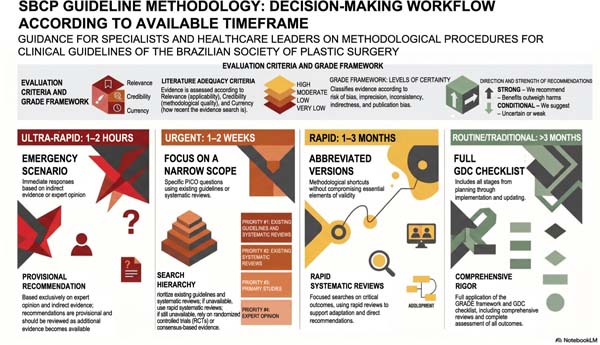
Four levels of guideline development are described according to the time available: ultra-rapid (1–2 hours); urgent (1–2 weeks); rapid (1–3 months); and traditional (>3 months). In more urgent scenarios, it is recommended that the scope of clinical questions be narrowed using frameworks such as PICO (Patient, Intervention, Control, and Outcomes) or PECO (Population, Exposure, Comparator, and Outcomes), prioritizing critical outcomes and relying, whenever possible, on previously published guidelines and systematic reviews. In the absence of such sources, the hierarchy of evidence should include randomized controlled trials, primary studies, and, ultimately, expert opinion.
The document identifies the Grading of Recommendations Assessment, Development and Evaluation (GRADE) approach as the primary framework for assessing the certainty of evidence and formulating recommendations. GRADE classifies evidence as high, moderate, low, or very low certainty based on domains such as risk of bias, inconsistency, imprecision, indirectness, and publication bias. The Summary of Findings (SoF) and Evidence to Decision (EtD) frameworks are also presented as tools for synthesizing evidence and supporting the translation of evidence into transparent clinical recommendations.
The proposed methodology emphasizes the critical appraisal of the literature according to criteria of relevance, credibility, and currency, as well as the possibility of adopting, adapting, or developing new recommendations. Tools such as AGREE II, AMSTAR 2, ROBIS, and ROBUST-RCT are described for the methodological assessment of guidelines, systematic reviews, and clinical trials. The document also addresses key GRADE concepts, including the minimally important difference (MID), assessment of imprecision, statistical inconsistency, indirectness, and risk of bias.
In formulating recommendations, consideration is given to the magnitude of benefits and harms, the certainty of the evidence, and patients’ values and preferences. Recommendations may be strong or conditional, either in favor of or against a given intervention, and should use standardized wording (“we recommend” for strong recommendations and “we suggest” for conditional recommendations).
Lastly, the document discusses rapid guidelines and the use of methodological shortcuts based on the GIN-McMaster Guideline Development Checklist (GDC) extension for rapid recommendations. Key elements include structured planning, prioritization of relevant clinical questions, virtual meetings, rapid evidence synthesis, methodological transparency, and planning for future updating into more comprehensive traditional guidelines. The final document is available as ►Annex 1 accompanying this article (online only).
Discussion
This narrative review synthesized methodological recommendations for the development of rapid guidelines, highlighting that although this format is intended to reduce the time required to develop recommendations, maintaining methodological rigor and transparency throughout the process remains essential. Rapid guidelines should provide information comparable to that of traditional guidelines, including an explicit description of the methods used and acknowledgment of potential limitations introduced by abbreviated approaches. Such transparency is critical to enabling users to appropriately interpret the certainty of the evidence and the strength of the recommendations.2
Although the WHO suggests that rapid guidelines be developed within 1 to 3 months, achieving this target remains challenging. Methodological studies have shown that the average time required for the development of rapid guidelines may be substantially longer, reaching an average of approximately 8.5 months, highlighting the complexity of the process even when abbreviated strategies are employed.2
Among the main barriers reported are limitations in human resources, particularly with respect to working group composition and methodological coordination, as well as the need for experts to become familiar with the rapid guideline development process. Limited availability of evidence and financial constraints may also hinder the development and implementation of these guidelines.3 The subjectivity involved in many of the key decisions related to rating the certainty of evidence and moving from evidence to recommendations within the GRADE framework also represents an important limitation.6
Another relevant aspect identified in this review is the importance of using strategies that optimize the development process, such as leveraging previously published guidelines, applying the ADOLOPMENT approach, prioritizing existing systematic reviews, and, when necessary, conducting rapid systematic reviews. The use of structured frameworks, such as SoF and EtD tables, also contributes to a more transparent process by facilitating the assessment of evidence certainty and the adaptation of recommendations to specific contexts. In addition, virtual meetings, preliminary voting among panel members, and clear definition of the scope and structured clinical questions are strategies that may improve efficiency without compromising methodological quality.
In plastic surgery, the need for rapid guidelines is particularly relevant given the frequent emergence of new techniques, devices, and interventions, often accompanied by limited evidence. In such scenarios, the development of recommendations based on structured methods becomes essential to guide clinical practice and to avoid the premature adoption of interventions that have not been adequately evaluated through critical appraisal of the available evidence.
The authors hope that the methodological synthesis presented herein will serve as a practical guide for the development of rapid guidelines with appropriate methodological rigor, particularly within the SBCP. The adoption of structured and transparent processes may contribute to the development of reliable, timely, and specialty-specific recommendations, thereby promoting greater consistency and quality in clinical decision-making.
Conclusion
Rapid guidelines represent an important tool for supporting decision-making in situations that require timely responses, such as the emergence of new evidence or novel interventions, circumstances that are common in plastic surgery. However, even within shortened timelines, their development must maintain methodological rigor, transparency, and a structured use of evidence to ensure the trustworthiness of recommendations. The synthesis presented in this study provides a set of practical recommendations for the development of rapid guidelines, systematically organized across the different stages of the process. It is hoped that this material will serve as a guide for the development of methodologically robust rapid guidelines, particularly within the SBCP, contributing to the production of reliable, transparent, and clinically applicable recommendations.
REFERENCES
1. WHO handbook for guideline development, 2nd Edition. https://www.who.int/publications/i/item/9789241548960
2. Kowalski SC, Morgan RL, Falavigna M, et al. Development of rapid guidelines: 1. Systematic survey of current practices and methods. Health Res Policy Syst 2018;16(01):61
3. Florez ID, Morgan RL, Falavigna M, et al. Development of rapid guidelines: 2. A qualitative study with WHO guideline developers. Health Res Policy Syst 2018;16(01):62
4. Green BN, Johnson CD, Adams A. Writing narrative literature reviews for peer-reviewed journals: secrets of the trade. J Chiropr Med 2006;5(03):101–117
5. Ferrari R. Writing narrative style literature reviews. Med Writ 2015;24:230–235
6. Guyatt G, Agoritsas T, Brignardello-Petersen R, et al. Core GRADE 1: overview of the Core GRADE approach. BMJ 2025;389:e081903
Supplementary Material S1 Methodology for the Development of Guidelines of the Brazilian Society of Plastic Surgery: Current Best Practices
Guidelines are systematic recommendations based on the best available evidence and the transparent judgment of experts and stakeholders, and are essential for guiding clinical practice, public health, and healthcare management. Their traditional development process is time-consuming and may require more than two years to complete. 1 However, in the face of relevant new evidence, the emergence of novel treatment modalities, or the need to respond rapidly to public concerns, recommendations may need to be developed within a shortened timeframe, requiring guideline development groups to balance timeliness with trustworthiness.2–4 Such situations are common in plastic surgery.
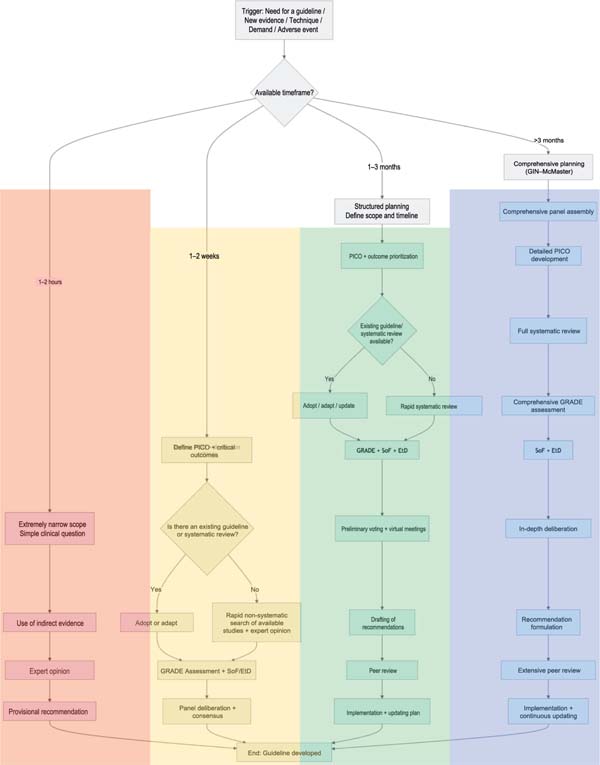
The literature describes four levels of urgency in guideline development: ultra-rapid (1–2 hours), urgent (1–2 weeks), rapid (1–3 months), and routine/traditional (>3 months). In urgent situations, it is essential to narrow the scope and formulate focused clinical questions, typically using frameworks such as PICO or PECO, which organize the population, intervention/exposure, comparator, and outcomes. The more precisely these elements are defined—particularly the target population and priority outcomes—the more feasible and efficient the development of trustworthy recommendations becomes.4 ►Supplementary Figure S1 provides an infographic summarizing the procedures recommended for each timeframe scenario, while ►Supplementary Figure S2 presents these procedures in the form of a detailed flowchart. For urgent guidelines (1–2 weeks), priority should be given to the use of existing guidelines and systematic reviews, avoiding the conduct of new reviews whenever possible. In the absence of these sources, evidence retrieval should follow a hierarchical approach, prioritizing randomized controlled trials, followed by other primary studies and, ultimately, expert opinion.4
Assessment of Literature Adequacy and the GRADE Framework
After identifying the relevant literature, its adequacy and certainty should be assessed using the Grading of Recommendations Assessment, Development and Evaluation (GRADE) framework, which classifies evidence as high, moderate, low, or very low certainty.5,6 This framework is widely used by organizations such as the World Health Organization (WHO), the Cochrane Collaboration, and the American Society of Plastic Surgeons (ASPS).
Recommendations are characterized by both their direction—either in favor of or against an intervention—and their strength. Recommendations are considered strong when the benefits clearly outweigh the risks and conditional (weak) when greater uncertainty exists.7
GRADE incorporates Summary of Findings (SoF) tables, which provide a standardized summary of intervention effects and the certainty of the evidence, as well as Evidence to Decision (EtD) frameworks, which support the translation of evidence into recommendations.8 While SoF tables summarize what the studies show, EtD frameworks guide how decisions should be made based on that evidence. These frameworks can be operationalized through tools such as the Interactive Evidence to Decision (iEtD) platform (available at https://ietd.epistemonikos.org/).9
Criteria for Relevance, Credibility, and Currency
After identifying the relevant literature—guidelines, systematic reviews, or, in their absence, primary studies—its adequacy should be assessed according to three criteria: relevance, credibility, and currency. Relevance refers to the direct applicability of the evidence to the clinical question; discrepancies between the evidence and the question increase indirectness. Credibility relates to methodological quality and may be assessed using instruments such as AGREE II10 (guidelines), AMSTAR-2,11 and ROBIS12 (systematic reviews). Currency depends on how recent the literature searches were and whether new evidence has emerged since publication, which can be assessed through a rapid update.4 This assessment does not need to encompass the entire body of literature, but only the evidence used to support the recommendation. Furthermore, it is not a dichotomous process: different sources may present limitations to varying degrees. In general, relevance, credibility, and currency should be prioritized in that order, such that more relevant evidence may be preferred even when it is less recent.4
Depending on the availability and adequacy of the literature, recommendations may be developed using one of four strategies: adoption of existing guideline recommendations, adaptation of existing recommendations, development of new recommendations based on available systematic reviews, or, in the absence of such evidence, reliance on expert opinion.4
Adoption or Adaptation of Existing Recommendations
The literature search may identify an existing guideline that is considered appropriate for the urgent question, meaning that it is relevant, credible, and current. In such cases, the expert panel should determine whether the recommendation will be adopted as originally presented or adapted to the new context. In practice, a recommendation is considered adopted when neither its direction nor its strength is modified. Conversely, when either of these elements is changed, the recommendation is considered adapted.4
To decide whether a recommendation should be adopted or adapted, the panel should assess whether contextual differences may affect its direction or strength, drawing particularly on the SoF and EtD tables provided in the original guideline. Factors such as the importance of outcomes, potential indirectness of the evidence, and reassessment of evidence certainty—including considerations related to risk of bias, imprecision, inconsistency, or the availability of new evidence—may justify modifications.
Accordingly, it is essential to critically review the original guideline’s GRADE assessment in light of the new context, which requires a basic understanding of the GRADE framework.4
Classification of Evidence Certainty in GRADE
The GRADE framework classifies the certainty of evidence into four levels (high, moderate, low, and very low), considering the body of evidence for each outcome rather than individual studies.7,13 Randomized controlled trials begin as high-certainty evidence, whereas non-randomized studies begin as low-certainty evidence. Evidence may be downgraded due to limitations such as risk of bias, imprecision, inconsistency, indirectness, and publication bias, or upgraded in specific circumstances, such as a large magnitude of effect or the presence of a dose–response gradient. For both randomized and non-randomized studies, downgrading is performed according to the severity of the identified limitations and may occur by one level (e.g., from high to moderate certainty) or by two levels (e.g., from high to low certainty).7
Importance of Outcomes and the Minimally Important Difference (MID)
When moving from evidence to recommendations, the panel should consider the importance of benefits, harms, and burdens from the patient perspective. The overall certainty of evidence is determined by the lowest certainty rating among the critical outcomes.7 In addition to determining whether an effect exists, it is essential to assess its clinical relevance.
For this purpose, the concept of the minimally important difference (MID) is used. The MID represents the smallest change perceived as important by patients. Accordingly, the assessment may focus either on the presence of an effect (relative to the null effect) or on its clinical importance (whether it exceeds the MID threshold). The certainty of evidence is then judged considering limitations such as imprecision, inconsistency, risk of bias, indirectness, and publication bias.14
Imprecision
Intervention studies aim to estimate the true effect of a treatment. In this context, the pooled estimate from a metaanalysis represents the best point estimate of that effect, whereas the confidence interval (CI), typically set at 95%, reflects the range within which the true effect is likely to lie. Studies with small sample sizes tend to produce more imprecise estimates,15 which is reflected in wider confidence intervals, particularly when they encompass both benefit and no effect.14
Within the GRADE framework, imprecision is assessed according to the position of the confidence interval relative to either the null effect or the minimally important difference (MID), and may result in downgrading the certainty of evidence by one or two levels. If the confidence interval crosses the selected threshold of interest—whether the null effect or the MID—the evidence should be downgraded for imprecision, regardless of sample size. When the confidence interval does not cross the threshold but the observed effect is very large (e.g., a relative risk reduction greater than 40%), caution is warranted because such large effects are uncommon. In these situations, if the number of participants is small, downgrading for imprecision is also recommended. This assessment is supported by the concept of the Optimal Information Size (OIS), which represents the ideal number of participants required in a meta-analysis. If the meta-analysis reaches the OIS, downgrading for imprecision is generally not warranted; otherwise, downgrading should be considered.
Inconsistency
In the GRADE framework, inconsistency refers to differences in the results of studies evaluating the same intervention. It is suggested when point estimates of treatment effects differ substantially, when confidence intervals show little overlap, or when they point in opposite directions, thereby reducing the certainty of the evidence.16
Inconsistency may arise from random variation or from true heterogeneity among studies, with the I2 statistic serving as the primary indicator of such variability. Low I2 values (<30%) rarely indicate important inconsistency, whereas higher values increase the likelihood that the certainty of evidence will be downgraded. However, interpretation of the I2 statistic should be undertaken cautiously, particularly when confidence intervals are very narrow.15,16
Risk of Bias
Risk of bias is a central domain within the GRADE framework and should be assessed using appropriate appraisal tools.17 In randomized controlled trials, instruments such as ROBUST-RCT18 evaluate domains including randomization, allocation concealment, blinding, and missing outcome data, classifying studies as having either low or high risk of bias. The certainty of evidence may be downgraded when important limitations are identified in one or more of these domains, and at the body-of-evidence level when studies at high risk of bias predominate (>55%) within the available evidence.
The impact of bias, however, depends on its likely direction. If a bias would be expected to overestimate an effect that was not observed, downgrading may not be warranted. Furthermore, when discrepancies exist between studies at high and low risk of bias, the analysis may focus on the lowrisk studies without necessarily downgrading the certainty of evidence.
Non-randomized controlled studies begin as low-certainty evidence and may be further downgraded according to assessments performed using instruments such as the Newcastle–Ottawa Scale.19 In the absence of factors warranting downgrading, their certainty may, under specific circumstances, be upgraded—for example, when a large magnitude of effect is observed (such as doubling a beneficial effect or halving the risk of an adverse outcome) or when a dose– response gradient is present—while remaining cautious regarding the potential influence of residual confounding. Case series and single-arm studies, by contrast, are generally considered very low-certainty evidence.
Publication Bias
Publication bias, another domain within the GRADE framework, occurs when studies—particularly those with negative or unfavorable results—remain unpublished, thereby distorting estimates of treatment effects. Its assessment is indirect and is often based on the evaluation of funnel plots. Although asymmetry in a funnel plot may suggest the presence of publication bias, it is not definitive evidence of its existence. The risk of publication bias is considered higher when the available evidence is dominated by small studies, particularly those funded by industry. In such situations, downgrading the certainty of evidence may be warranted.17
Indirectness
Indirectness, the final GRADE domain, refers to discrepancies between the clinical question (population, intervention, comparator, outcome [PICO]) addressed by the guideline under development and the available evidence. It occurs when there are differences in the population, intervention, comparator, or outcomes. Not every difference requires downgrading; however, downgrading may be warranted when such discrepancies are likely to influence the expected effect.
This may occur, for example, when evidence is extrapolated across populations with substantially different clinical characteristics or when it is based on outdated technologies. Indirectness may also arise when the outcomes evaluated do not directly reflect what is important to patients, such as when surrogate outcomes are used. Surrogate outcomes are indirect measures—typically laboratory or intermediate outcomes—that do not directly represent clinically important benefits but instead serve as markers of the intervention’s effects. In such situations, when the available evidence does not adequately correspond to the target context or to clinically relevant outcomes, the certainty of evidence should be downgraded.20
Additional Considerations
When meta-analysis is not feasible because of incompatible or insufficient data, narrative synthesis may be used. In such cases, evidence should continue to be assessed by outcome, and the same GRADE domains should be applied to classify the certainty of evidence.8 The Synthesis Without Meta-analysis (SWiM) reporting guideline provides additional guidance on this process.21
When both randomized and non-randomized studies are available, higher-certainty evidence should generally be prioritized. When the certainty of evidence is similar, findings from both study designs may be presented. In addition to the GRADE domains, contextual factors may also be considered when formulating recommendations, including the perspective of the guideline (individual or population-based), resource use, equity, acceptability, and feasibility.22 The decision to adapt recommendations depends on the existence of meaningful differences between the context of the original guideline and the current setting. When recommendations are adapted, the rationale for these modifications should be explicitly described, and the wording of the recommendations may be adjusted to improve their applicability to the target audience.4
Formulation of Recommendations in GRADE
Within the GRADE framework, recommendations are characterized by both their direction (for or against an intervention) and their strength (strong or conditional), resulting in four principal categories, in addition to the rare option of restricting an intervention to research settings. Strong recommendations are issued when there is a clear balance between benefits and harms favoring one course of action and when well-informed patients would be expected to make similar choices. Conditional recommendations, by contrast, reflect greater uncertainty or variability in patient values and preferences and generally require shared decision-making23 (►Supplementary Figure S3).
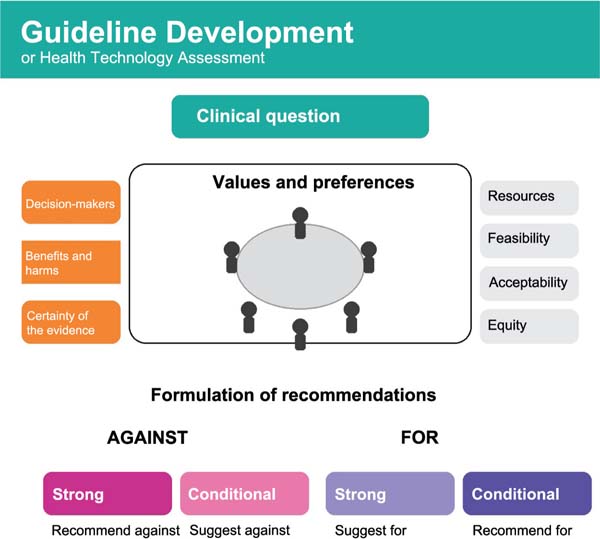
The formulation of recommendations is based on three pillars: the magnitude of benefits, harms, and burdens; the certainty of the evidence; and patient values and preferences, often organized using Evidence to Decision (EtD) frameworks. The magnitude of benefits is interpreted in light of the minimally important difference (MID), assessing whether the intervention exceeds this threshold. The MID may be derived from the literature, determined through patient interviews, or, in the absence of such information, established by consensus among panel members.
The determination of the direction and strength of recommendations depends initially on the certainty of the evidence and subsequently on the balance between the benefits and harms of the intervention.
When evidence is of high or moderate certainty and the balance of benefits and harms clearly favors an intervention, a strong recommendation should be issued. Conversely, when the balance between benefits and harms is less clear, the recommendation will generally be conditional.
When evidence is of low or very low certainty, recommendations will generally be conditional, regardless of whether the balance of benefits and harms favors the intervention. However, in exceptional circumstances, a strong recommendation may still be issued despite low-certainty evidence, such as when an intervention is associated with substantial risk or important harm. GRADE also standardizes recommendation wording: “we recommend” is used for strong recommendations, whereas “we suggest” is used for conditional recommendations, avoiding ambiguous expressions such as “consider.” The present text provides a simplified overview of the GRADE framework; more detailed information is available in the methodological literature.7,8,14,16,17,20,23
Recommendations in Settings with Limited Evidence or Extreme Urgency
In addition to adopting or adapting recommendations from existing guidelines, new recommendations may be developed in urgent situations (1–2 weeks) when new evidence emerges after the publication of previous guidelines or, in the absence of such guidelines, on the basis of appropriate systematic reviews. In these circumstances, recommendations should follow the GRADE framework, with methodological simplifications introduced when necessary to meet time constraints.24
When neither guidelines nor systematic reviews are available, recommendations developed in urgent situations (1–2 weeks) may be based on expert evidence, as there is insufficient time to conduct rapid systematic reviews. In such cases, the panel reviews the available literature in a non-systematic manner within the limited timeframe and records its judgments using EtD frameworks. These assessments are subsequently consolidated and discussed until consensus is reached through deliberation or voting.4
In ultra-rapid emergency situations (1–2 hours), it may be necessary to rely on indirect evidence, with corresponding downgrading for indirectness. Under these extreme circumstances, recommendations may be based exclusively on expert opinion, without systematic reviews or the participation of methodologists. Such recommendations should be explicitly considered provisional and subject to revision as additional time becomes available for panel deliberation or as new evidence emerges25–27 (►Supplementary Figure S2).
Rapid Guidelines and the Use of Methodological Shortcuts
When neither ultra-rapid emergency situations (1–2 hours) nor urgent situations (1–2 weeks) apply, rapid guidelines (1–3 months) may be developed. These guidelines employ abbreviated versions of the traditional methodological process, with the central challenge being the reduction of procedural steps without compromising validity or credibility. To achieve this, it is essential to preserve the core methodological elements, thereby ensuring that recommendations remain trustworthy22 (►Supplementary Figure S2). For traditional guidelines (>3 months), the Guideline International Network (GIN)–McMaster Guideline Development Checklist (GDC) is one of the principal methodological references. This comprehensive checklist provides guidance for all stages of the guideline development process, from planning to implementation and updating, and has become an international standard for the development of traditional guidelines.3,28
To specifically support the development of rapid guidelines, an extension of the GDC was published in 2018, defining the essential principles that should be maintained even when abbreviated processes are used.22
The initial principles of rapid guideline development emphasize structured planning and pragmatism. The available timeframe should first be defined, along with the components of the GDC that will be retained. The methodology should then be adapted according to resource limitations without compromising quality. Whenever possible, a target completion date should be established in advance.22
Early planning is essential and includes the development of standard operating procedures, preparation of templates, early identification of reviewers, and organization of panel meetings. The rationale for developing a rapid guideline should also be clearly justified, typically based on the emergence of important new evidence regarding safety, effectiveness, or cost-effectiveness, or on the need for timely guidance.
The need for emergency recommendations prior to the rapid guideline should likewise be assessed and, when necessary, incorporated into the planning process. The development group should include key members, although its size may be reduced to facilitate efficiency. When feasible, additional resources may be allocated to optimize the process, including the recruitment of additional personnel and dedicated full-time staff. Conflict-of-interest management should be conducted efficiently and may require restrictions on panel composition. Nevertheless, in certain circumstances, the participation of experts with highly specialized knowledge may still be necessary despite potential conflicts of interest.
Subsequent principles focus on organizational structure and operational efficiency. The creation of a database of subject-matter experts facilitates rapid panel assembly and reviewer selection. When timelines are limited, virtual meetings should be prioritized to accelerate decision-making. The target audience and topic of the guideline should also be defined in advance and, whenever possible, communicated early in the process.
The formulation of PICO questions should reflect available resources, emphasizing precision and, when necessary, reducing both the number of questions and the overall scope of the guideline. Appropriate prioritization of questions is essential and should be clearly documented to ensure transparency.
The assessment should be restricted to the most important (critical) outcomes for decision-making while ensuring that both benefits and harms are considered. These outcomes may be defined iteratively by panel members, with their relevance progressively refined throughout the process.
Patient values and preferences remain central to recommendation development and may be assessed indirectly through the literature or, when such information is unavailable, through the collective experience of the panel, provided that this approach adequately reflects the patient perspective.
The search and evidence-synthesis strategy should reflect the resources available, prioritizing the use of existing guidelines or systematic reviews, which may be adopted, adapted, or updated as previously described in urgent situations. When adaptation is required, specific methodologies such as ADOLOPMENT24 and ADAPTE may be used.29,30
In the context of rapid guidelines (1–3 months), when neither guidelines nor systematic reviews are available, rapid systematic reviews are recommended, and their methodology has been well described in the medical literature.13,31–38
In addition, primary studies and expert contributions may complement the Summary of Findings (SoF) tables of the new rapid guideline. Recommendation development may be accelerated through preliminary voting, with SoF tables distributed to panel members in advance. Areas of disagreement may subsequently be discussed during virtual meetings with the goal of reaching consensus, supported by tools such as GRADEpro (available at https://www.gradepro.org/). For many clinical questions, published evidence may be limited or unavailable. In such circumstances, the panel may decide not to issue recommendations, rely on expert opinion, or seek to generate primary data. When sufficient time is available, one possible strategy is to obtain information through structured online surveys involving experts with relevant subject-matter expertise, thereby collecting unpublished observations and case series. The resulting recommendations will generally be based on very low-certainty evidence; nevertheless, such a synthesis, despite its limitations, is often more robust than decisions based exclusively on expert opinion.39
The wording of recommendations should be determined during panel meetings, ideally in parallel with the evaluation of the evidence, using standardized language that explicitly communicates the direction of the recommendation first and its strength second. In general, recommendations should be formulated in favor of a particular course of action rather than against a specific approach. However, when an ineffective or potentially harmful intervention is widely used, a recommendation against that practice may be appropriate.23 Transparency is essential throughout the process, particularly when evidence is limited, and the methods used for evidence review and appraisal should be clearly documented. Peer review remains a critical stage of guideline development and may be expedited through the prior identification of reviewers and the establishment of predefined timelines.
Consideration should also be given to the implementation of the rapid guideline, including the assessment of feasibility and potential barriers, which should be explicitly described. Finally, it is advisable to establish in advance a timeline for the development of a traditional guideline following the recommendations of the Guideline International Network (GIN)–McMaster Guideline Development Checklist (GDC),28 thereby ensuring a future update and a more comprehensive evaluation of the recommendations.22
1. Plastic Surgery, Universidade Federal de São Paulo (UNIFESP), São Paulo, SP, Brazil
2. Brazilian Society of Plastic Surgery, São Paulo, SP, Brazil
3. Universidade do Estado do Rio de Janeiro (UERJ), Rio de Janeiro, RJ, Brazil
4. Centro Universitário Unieuro, Brasília, DF, Brazil
5. Faculdade de Medicina da Universidade Federal da Bahia (UFBA), Salvador, BA, Brazil
6. Faculdade de Medicina de Ribeirão Preto da Universidade de São Paulo (FMRP-USP),
São Paulo, SP, Brazil
7. Universidade Federal do Paraná (UFPR), Curitiba, Paraná, Brazil
8. Fundação Hospitalar do Estado de Minas Gerais (FHEMIG), Belo Horizonte, MG, Brazil
Data Availability Data will be available upon request to the corresponding author.
Address for correspondence Juan Carlos Montano Pedroso, Disciplina de Cirurgia Plástica da Universidade Federal de São Paulo (UNIFESP), São Paulo, SP, CEP, Brazil (e-mail: juancmontano@gmail.com).
Article received: May 18, 2026.
Article accepted: June 01, 2026.
Conflict of Interests The authors have no conflict of interests to declare.
Editor-chefe: Dov Charles Goldenberg.
 Read in Portuguese
 Read in English
 PDF PT
 Print
Print
 Send this article by email
 How to Cite
 Mendeley
 Pocket
 Facebook
 Twitter