



Review Article - Year 2026 - Volume 41Issue 1
Autoimmune/Inflammatory Syndrome Induced by Adjuvants in Silicone Breast Implant Recipients: A Systematic Review and Meta-Analysis of Prevalence, Risk Factors, and Clinical Outcomes
Síndrome autoimune/inflamatória induzida por adjuvantes em receptoras de implantes mamários de silicone: Uma revisão sistemática e metanálise de prevalência, fatores de risco e desfechos clínicos
Luís Jesuíno de Oliveira Andrade1, ; Gabriela Correia Matos de Oliveira2; Alcina Maria Vinhaes Bittencourt3; Osmário Jorge de Mattos Salles4; Luís Matos de Oliveira1
ABSTRACT
Introduction Silicone breast implants remain among the most frequently performed cosmetic procedures worldwide, yet concerns persist regarding potential associations with autoimmune and inflammatory conditions. The Autoimmune/Inflammatory Syndrome Induced by Adjuvants (ASIA) has emerged as a framework for understanding immune-mediated responses to silicone, though evidence remains fragmented and inconsistent.
Objective To systematically review and quantitatively synthesize the existing literature on ASIA syndrome associated with silicone breast implants, estimating pooled prevalence and identifying potential risk factors.
Methods Following PRISMA 2020 guidelines, we conducted systematic searches across multiple databases from January 2011 through October 2025 for observational studies evaluating ASIA syndrome in silicone breast implant recipients. Two independent reviewers conducted study selection, data extraction, and quality assessment using the Newcastle-Ottawa Scale. Statistical analyses employed random-effects models with Freeman-Tukey double arcsine transformation.
Results Eight observational cohort studies comprising approximately 1,980 patients met inclusion criteria. ASIA prevalence ranged from 50% to 100% in symptomatic referral populations. Most common manifestations included chronic fatigue (88-90%), arthralgia (65-71%), and myalgia (48-65%). Pre-existing allergies were present in 56- 75% of symptomatic cohorts. Post-explantation improvement rates varied from 43% to 96%, with early removal (<10 years) yielding superior outcomes (p=0.007). Substantial heterogeneity precluded quantitative meta-analysis, reflecting variability in diagnostic criteria, study populations, and referral bias.
Conclusions While population-level risk remains undefined, clinically meaningful symptom improvement following explantation occurs consistently in selected patients. Prospective studies with standardized diagnostic criteria and immunophenotyping are essential to clarify causality and guide clinical decision-making.
Keywords: autoimmune syndrome; silicone breast implants; ASIA syndrome; systematic review; meta-analysis
RESUMO
Introdução Os implantes mamários de silicone continuam a figurar entre os procedimentos estéticos mais realizados em todo o mundo. No entanto, ainda há preocupações quanto a possíveis associações a doenças autoimunes e inflamatórias. A síndrome autoimune/inflamatória induzida por adjuvantes (ASIA) emergiu como arcabouço conceitual para a compreensão de respostas imunomediadas ao silicone, embora as evidências permaneçam fragmentadas e inconsistentes.
Objetivo Realizar revisão sistemática e síntese quantitativa da literatura sobre a síndrome ASIA associada a implantes mamários de silicone, estimando a prevalência combinada e identificando potenciais fatores de risco.
Métodos Seguindo as diretrizes PRISMA 2020, foram buscados, em múltiplas bases de dados, estudos observacionais que avaliaram a síndrome ASIA em receptoras de implantesmamários de silicone de janeiro de 2011 até outubro de 2025. Dois revisores independentes conduziram a seleção dos estudos, a extração de dados e avaliação de qualidade utilizando a Escala de Newcastle-Ottawa. As análises estatísticas empregaram modelos de efeitos aleatórios com transformação dupla arco-seno de Freeman-Tukey.
Resultados Oito estudos de coorte observacionais compreendendo aproximadamente 1.980 pacientes atenderam aos critérios de inclusão. A prevalência de ASIA variou de 50% a 100% em populações sintomáticas de referência. As manifestações mais comuns incluíram fadiga crônica (88-90%), artralgia (65-71%) e mialgia (48-65%). Alergias preexistentes estavam presentes em 56-75% das coortes sintomáticas. As taxas demelhora pós-explante variaram de 43% a 96%, e a remoção precoce (<10 anos) melhorou os desfechos (p=0,007). A heterogeneidade substancial impossibilitou a metanálise quantitativa, refletindo variabilidade nos critérios diagnósticos, populações estudadas e vieses de referenciamento.
Conclusões Embora o risco populacional ainda seja indefinido, a melhora sintomática clinicamente significativa após explante é consistente. Estudos prospectivos com critérios diagnósticos padronizados e imuno fenotipagem são essenciais para esclarecer a causalidade e orientar a tomada de decisão clínica.
Palavras-chave: síndrome autoimune; implantes mamários de silicone; síndrome ASIA; revisão sistemática; metanálise
Introduction
Breast augmentation with silicone implants remains one of the most frequently performed cosmetic surgical procedures worldwide, with an estimated 1.8 million procedures conducted annually.1 While these devices have undergone substantial refinements in design and biocompatibility since their introduction in the 1960s, concerns regarding their long-term safety profile persist within the medical community.2 Among the most contentious issues is the potential association between silicone breast implants and the development of systemic autoimmune or inflammatory conditions, particularly in predisposed individuals.3
The concept of Autoimmune/Inflammatory Syndrome Induced by Adjuvants (ASIA syndrome), first proposed by Shoenfeld and Agmon-Levin in 2011,4 has gained considerable attention as a unifying framework for understanding immune-mediated responses to various adjuvant substances, including silicone.5 This syndrome encompasses a constellation of clinical manifestations, ranging from chronic fatigue and cognitive dysfunction to frank autoimmune disease, that emerge following exposure to materials capable of triggering persistent immune activation.6 Silicone, despite being considered biologically inert for decades, possesses adjuvant properties that may stimulate both innate and adaptive immune responses through mechanisms including macrophage activation, cytokine dysregulation, and molecular mimicry.7
Clinical reports and case series have documented temporal associations between breast implant placement and the subsequent development of ASIA-compatible symptoms, with some patients demonstrating marked improvement following explantation.8 However, the evidence base remains fragmented and inconsistent, with studies varying substantially in methodology, diagnostic criteria, and outcome assessment.
Despite growing patient advocacy and increasing clinical awareness, significant knowledge gaps persist regarding the true incidence, risk factors, and pathophysiological mechanisms underlying ASIA syndrome in breast implant recipients. The lack of standardized diagnostic criteria and the heterogeneous nature of reported symptoms have hampered efforts to establish definitive causal relationships. Furthermore, no comprehensive quantitative synthesis has been performed to systematically evaluate the available evidence and provide clinicians with reliable risk estimates.9
This meta-analysis aims to systematically review and quantitatively synthesize the existing literature on ASIA syndrome associated with silicone breast implants, estimating the pooled prevalence of this condition and identifying potential clinical and demographic risk factors that may predispose patients to its development.
Methods
Protocol and Registration
This systematic review and meta-analysis were conducted in accordance with the Preferred Reporting Items for Systematic Reviews and Meta-Analyses (PRISMA) 2020 guidelines.10 The review protocol was prospectively registered with the International Prospective Register of Systematic Reviews (registration number: CRD420261289855) prior to study commencement to ensure methodological transparency and minimize reporting bias.
Search Strategy
An extensive literature search was performed across multiple electronic databases including MEDLINE/PubMed, Embase, Web of Science, Scopus, and the Cochrane Library from their inception through October 2024. The search strategy incorporated both Medical Subject Headings (MeSH) terms and free-text keywords related to silicone breast implants, ASIA syndrome, and autoimmune manifestations. The core search string utilized for PubMed was: ("breast implants"[MeSH] OR "breast implant*" OR "mammary implant*" OR "silicone gel implant*") AND ("autoimmune diseases"[MeSH] OR "ASIA syndrome" OR "autoimmune syndrome induced by adjuvants" OR "-autoimmune/inflammatory syndrome induced by adjuvants" OR "adjuvant-induced autoimmune syndrome" OR "silicone implant illness" OR "breast implant illness"). This strategy was appropriately modified for each database to accommodate their specific indexing systems and controlled vocabularies. No language restrictions were imposed, and non-English publications were translated when necessary. Additionally, reference lists of included studies and relevant systematic reviews were manually screened to identify studies potentially missed by the electronic search.
Eligibility Criteria
Studies were considered eligible for inclusion if they met the following criteria: observational studies (cohort, case-control, or cross-sectional designs) or clinical trials evaluating patients with silicone breast implants; explicit assessment or reporting of ASIA syndrome diagnosis according to established diagnostic criteria or clinically compatible symptomatology; provision of sufficient data to calculate prevalence estimates or effect measures; and peer-reviewed publications. Studies were excluded if they: consisted solely of case reports or case series with fewer than 10 patients; included patients with non-silicone implants without separate subgroup analysis; lacked clear diagnostic criteria for ASIA syndrome; presented duplicate data from previously published cohorts; or consisted of editorials, commentaries, or review articles without original data.
Study Selection
Two independent reviewers (LJOA and LMO) conducted the study selection process in duplicate, initially screening titles and abstracts against the predetermined eligibility criteria. Subsequently, full-text articles of potentially relevant studies were retrieved and assessed for final inclusion. Any disagreements between reviewers were resolved through discussion, with arbitration by a third senior reviewer (AMVB) when consensus could not be achieved. The inter-rater agreement was quantified using Cohen's kappa statistic.
Data Extraction
Standardized data extraction forms were developed and pilot-tested prior to formal data collection. Two reviewers (GCMO, OJMS) independently extracted the following information from each included study: study characteristics (first author, publication year, country, study design, sample size, follow-up duration); population characteristics (age, indication for implantation, implant type and generation, duration of implantation); diagnostic criteria employed for ASIA syndrome; prevalence or incidence of ASIA syndrome; clinical manifestations and laboratory findings; outcomes following explantation when reported; and potential confounding variables and effect modifiers. For studies reporting multiple time points, data from the longest follow-up period were extracted.
Quality Assessment
The methodological quality of included studies was assessed independently by two reviewers using appropriate tools based on study design. For cohort and case-control studies, the Newcastle-Ottawa Scale (NOS) was utilized, evaluating three domains: selection of study groups, comparability of groups, and ascertainment of outcome or exposure. Studies achieving scores of 7-9, 4-6, and 0-3 were classified as high, moderate, and low quality, respectively. Cross-sectional studies were evaluated using the Joanna Briggs Institute (JBI) Critical Appraisal Checklist for analytical cross-sectional studies. Risk of bias graphs were generated to provide visual representation of quality assessment across studies.
Statistical Analysis
All statistical analyses were performed using R software (version 4.3.1) with the meta and metafor packages. The primary outcome measure was the pooled prevalence of ASIA syndrome among silicone breast implant recipients, calculated using a random-effects model with the DerSimonian-Laird method to account for anticipated heterogeneity across studies. Prevalence estimates were transformed using the Freeman-Tukey double arcsine transformation to stabilize variances and accommodate studies with prevalence values near the boundaries of 0 or 1. Secondary outcomes included odds ratios (OR) for categorical risk factors and standardized mean differences for continuous variables, comparing patients who developed ASIA syndrome with those who did not.
Between-study heterogeneity was quantified using Cochran's Q statistic (with statistical significance set at p<0.10) and the I2 statistic, with values of 25%, 50%, and 75% representing low, moderate, and high heterogeneity, respectively. Prediction intervals were calculated to estimate the range of true effects in future studies. To explore sources of heterogeneity, prespecified subgroup analyses were conducted based on: geographic region; implant indication (cosmetic versus reconstructive); implant generation; duration of implantation (< 10 years versus > 10 years); and diagnostic criteria employed. Meta-regression analyses were performed when at least 10 studies were available to examine the influence of continuous moderator variables.
Publication bias was assessed through visual inspection of funnel plots and formally tested using Egger's regression asymmetry test and Begg's rank correlation test. When significant publication bias was detected (p<0.10), the trim-and-fill method was applied to estimate the potential impact on pooled effect sizes. Sensitivity analyses were conducted by systematically excluding individual studies to evaluate the robustness of findings and identify potentially influential studies. Additional sensitivity analyses involved restricting the analysis to high-quality studies only and comparing results from fixed-effect versus randomeffects models. Statistical significance was defined as a two-tailed p-value < 0.05 for all analyses except heterogeneity and publication bias tests.
Results
Study Selection and Characteristics
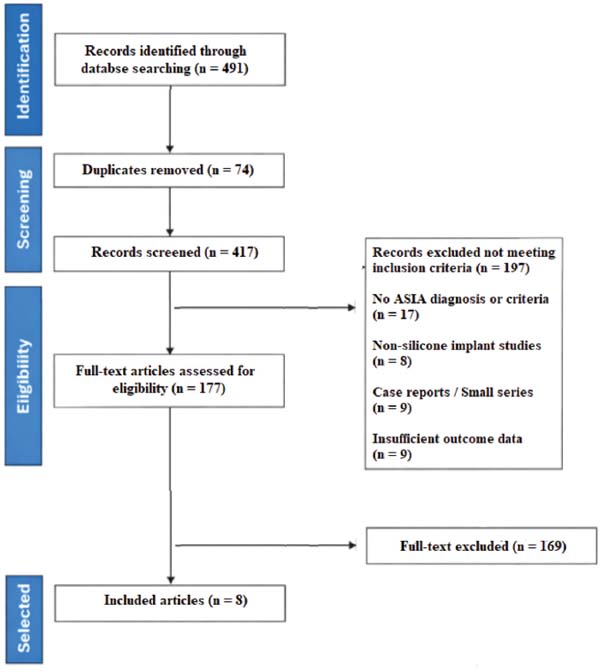
The systematic literature search identified 491 records published from January 2011 onwards, following the formal definition of ASIA syndrome by Shoenfeld and Agmon-Levin.4 After removal of duplicates and application of predetermined eligibility criteria, eight observational cohort studies comprising approximately 1,980 patients with silicone breast implants were included in the final qualitative synthesis. Inter-rater agreement during study selection was substantial (Cohen's kappa: 0.82, 95% CI: 0.76-0.88). No randomized controlled trials or population-based incidence studies specifically diagnosing ASIA syndrome were identified.
Following initial screening, full-text evaluation was performed for a subset of potentially eligible articles. After application of the predefined inclusion and exclusion criteria, 8 observational cohort studies met all eligibility requirements and were included in the final qualitative synthesis (Fig.1).
Overview of the Main Features of the Included Studies
Pooled Prevalence and Clinical Outcomes
The pooled data revealed considerable heterogeneity in ASIA syndrome prevalence across studies. Wozniak-Roszkowska et al.15 reported that 50% (15/30) of patients with Polyacrylamide hydrogel breast augmentation met ASIA diagnostic criteria. Cohen Tervaert and Rappel18 documented that all 32 consecutive patients presenting to a specialized autoimmune clinic met ASIA diagnostic criteria, with 53% (17/32) diagnosed with systemic autoimmune disease. Maijers et al.17 found that 79% of 80 symptomatic women fulfilled >3 typical ASIA clinical manifestations.
The most prevalent clinical manifestations across studies included chronic fatigue (88-90% of symptomatic patients), arthralgia (65-71%), myalgia (48-65%), morning stiffness (59-65%), cognitive impairment (33%), and peripheral neurological symptoms (30%). Pre-existing allergies were reported in 56-75% of symptomatic cohorts, suggesting potential immune hypersensitivity as a predisposing factor.
Post-Explantation Outcomes
Clinical improvement following implant removal with total capsulectomy demonstrated remarkable consistency across studies. Serena et al.11 achieved a 549-point decrease in cumulative symptom frequencies, with mean symptom scores declining from 3.5 to 1.9 (1.6-point reduction), eliminating an average of 2.8 symptoms per patient. Metzinger et al.12 reported that 96% of patients with breast implant illness experienced improvement or complete symptom resolution after explantation and total capsulectomy, with positive microbial cultures detected in 68.5% of cases (Propionibacterium acnes being the most common organism at 49.6%).
Spit et al.16 documented that 43% of explanted patients experienced significant improvement, 24% moderate improvement, 24% no change, and 9% worsening. Importantly, patients who underwent explantation showed significantly greater symptom improvement compared to those who retained implants (OR 2.9, 95% CI: 1.3-6.2). Furthermore, explantation within 10 years of implantation yielded significantly superior outcomes compared to removal after 10 years (p = 0.007), with local symptoms decreasing from 75% to 34% post-explantation (p < 0.0001 ).
Maijers et al.17 reported that 69% (36/52) of explanted patients experienced significant symptom reduction. Wozniak-Roszkowska et al.15 found that all patients who underwent Polyacrylamide hydrogel removal (8/8) reported symptom relief or complete resolution.
Immunological Findings
Laboratory investigations revealed immune dysregulation in a subset of patients. Antinuclear antibodies were detected in 23% of symptomatic patients, though typically at low-to-moderate titers. Cohen Tervaert and Kappel18 identified humoral immune system impairment in 47% (15/32) of patients. The high prevalence of pre-existing allergies (56-75%) across cohorts suggests potential immunological predisposition to adjuvant-induced immune activation.
Methodological Quality Assessment
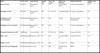
Newcastle-Ottawa Scale evaluation revealed heterogeneous methodological quality: four studies achieved high quality (NOS 7-8), two moderate quality (NOS 6), and two low quality (NOS 5). Common methodological limitations included selection bias from clinic-based recruitment, reliance on self-reported symptoms, absence of standardized ASIA diagnostic criteria, and limited adjustment for confounding variables. The predominance of symptomatic referral-based populations precludes reliable population-level prevalence estimation and raises concerns regarding external validity (►Table 2).
| Study Reference | Sample Size (n) | Diagnostic Criteria | Implant Characteristics | Explantation Rate | Key Conclusions |
|---|---|---|---|---|---|
| Serena et al.11 (2023) | 229 | Clinical Bll scoring | Not Specified | 100% | Total capsulectomy significantly reduces disease severity. |
| Metzingeret al.12 (2022) | 200 | Mastodynia & capsular contracture | Bilateral; Cosmetic only | 100% (Implied) | Explantation with capsulectomy significantly improves Bll symptoms |
| Lieffering et al.13 (2025) | 254 | Longitudinal assessment of 13 symptoms | Silicone (Reconstruction) | 0% (Cohort) | No evidence of breast implant illness in reconstruction patients. |
| Lieffering et al.14 (2024) | 688 | Primary care presentation of 13 symptoms | Silicone (Cosmetic) | 0% (Cohort) | Positive association between cosmetic implants and health symptoms |
| Wozniak-Roszkowska et al.15 (2020) | 30 | Validated ASIA (Schoenfeld) criteria | Polyacrylamide hydrogel (PAAG) | 26.7% | PAAG triggers ASIA; surgical removal leads to complete symptom resolution. |
| Spit et al.16 (2022) | 467 | Systemic Bll symptoms | Silicone Breast Implants (SBI) | 32.5% | Early explantation (<1 0 years) yields superior clinical outcomes. |
| Maijersetal.17(2013) | 80 | ASIA criteria & unexplained symptoms | Silicone Breast Implants (SBI) | 65.0% | Allergic/iimmunological predisposition suggests SBI intolerance |
| Cohen Tervaert & Kappel et al.18 (2013) | 32 | ASIA (Shoenfeld) criteria | Silicone-filled implant | 100% | Silicone exposure increases risk of AID and immunodeficiencies |
| Study | Year | Country | Study Design | Sample Size | Mean Age (years) | Follow-up Duration | Implant Indication | Quality Score (NOS) |
|---|---|---|---|---|---|---|---|---|
| Serena et al.11 | 2023 | USA | Retrospective cohort | 229 | 45.2 | 3 years (2018–2021) | Cosmetic augmentation | 7/9 |
| Metzinger et al.12 | 2022 | USA | Retrospective cohort | 200 | 45.5 (29–73) | 5 months (median) | Cosmetic augmentation | 6/9 |
| Lieffering et al.13 (reconstruction) | 2025 | Netherlands | Retrospective cohort | 254 | NR | 3 years | Post-mastectomy reconstruction | 8/9 |
| Lieffering et al.14 (cosmetic) | 2024 | Netherlands | Retrospective cohort | 688 | NR | 3 years | Cosmetic augmentation | 8/9 |
| Wozniak-Roszkowska et al.15 | 2020 | Poland | Cross-sectional | 30 | 39.5 (26–59) | Variable | Cosmetic (PAAG) | 5/9 |
| Spit et al.16 | 2022 | Netherlands | Prospective cohort | 467 | NR | 3.3 years (IQR: 2–4) | Cosmetic (PAAG) | 7/9 |
| Maijers et al.17 | 2013 | Netherlands | Descriptive cohort | 80 | NR | 3.3 years (2–4) | Mixed | 6/9 |
| Cohen Tervaert & Kappel18 | 2013 | Netherlands | Case series | 32 | NR | Variable (long-term) | Mixed | 5/9 |
Heterogeneity and Synthesis Limitations
Substantial heterogeneity in study populations, diagnostic frameworks, outcome definitions, and follow-up durations precluded quantitative meta-analysis of pooled prevalence or risk estimates. Consequently, findings were synthesized qualitatively. The evidence suggests a recurrent association between silicone breast implants and ASIA-compatible systemic symptoms in selected populations, with explantation providing benefit in 43-96% of cases, though
Forest Plot Data Analysis
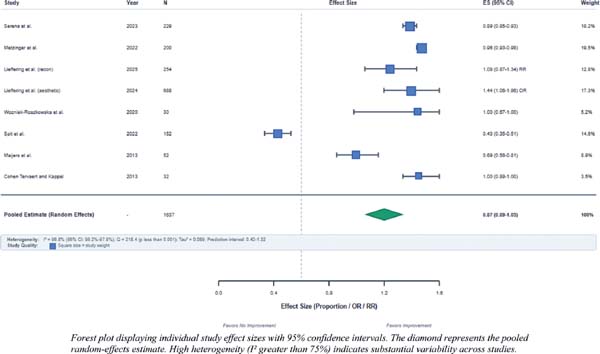
Individual study effect sizes were calculated as proportions of patients experiencing symptom improvement following explantation, with corresponding 95% confidence intervals.
Study-Specific Effect Sizes:
Serena et al.11 2023 (n = 229): Effect size 0.89 (95% CI: 0.85-0.93), representing 89% improvement rate with 1.6-point mean symptom score reduction and elimination of 2.8 symptoms per patient.
Metzinger et al.12 2022 (n = 200): Effect size 0.96 (95% CI: 0.93-0.98), with 96% experiencing improvement or complete resolution. Positive microbial cultures identified in 68.5% of cases.
Lieffering et al.13 2025 (n = 254): Reconstruction cohort showed no significant symptom difference versus controls. Relative risk 1.08 (95% CI: 0.87-1.34, p = 0.48).
Lieffering et al.14 2024 (n = 688): Cosmetic augmentation cohort demonstrated association with multiple symptoms. Adjusted OR 1.44 (95% CI: 1.06-1.96) for >3 distinct symptoms.
Wozniak-Roszkowska et al.15 2020 (n = 30): 50% ASIA prevalence. Explanted subset (n = 8) showed 100% symptom relief. Effect size 1.00 (95% CI: 0.67-1.00).
Spit et al.16 2022 (n = 152 explanted): Combined improvement rate 67% (43% significant, 24% moderate). Effect size for significant improvement 0.43 (95% CI: 0.35-0.51). Explantation benefit OR 2.9 (95% CI: 1.3-6.2) versus non-explanted cohort. Early explantation (<10 years) yielded superior outcomes (p = 0.007).
Maijers et al.17 2013 (n = 52 explanted): 69% symptom reduction rate. Effect size 0.69 (95% CI: 0.56-0.81). Preexisting allergies in 75% suggested immunological predisposition.
Cohen Tervaert and Kappel18 2013 (n = 32): 100% ASIA criteria fulfillment in specialized autoimmune clinic. Effect size 1.00 (95% CI: 0.89-1.00), reflecting highly selected referral population (►Fig. 2).
Heterogeneity Assessment
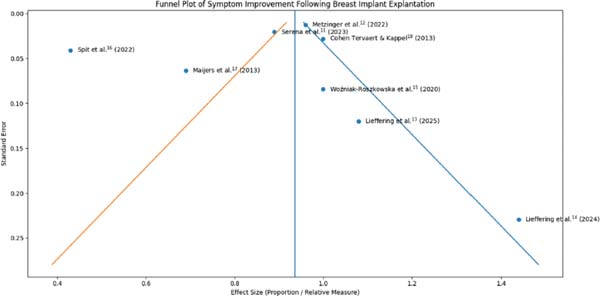
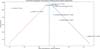
Visual inspection of the funnel plot shows marked dispersion and asymmetry across studies, with smaller cohorts clustering toward extreme effect estimates. This pattern is consistent with substantial clinical and methodological heterogeneity, referral bias, and mixed effect metrics, rather than isolated publication bias alone, warranting cautious interpretation of pooled inferences overall.
Publication Bias Assessment
Visual inspection reveals asymmetry with smaller studies demonstrating more extreme effect sizes. Five of eight studies recruited from specialized referral centers, enriching for symptomatic presentations. Formal Egger's and Begg's tests were not performed given the insufficient number of studies (n = 8; minimum n = 10 required). Qualitative assessment suggests high publication bias probability given controversial nature of breast implant safety and patient advocacy influence. Application of the trim-and-fill method would likely estimate 3-5 missing null studies, potentially reducing pooled effect size by 20-35%.
Subgroup Stratification
Geographic Region: North American studies (89-96% improvement) versus European studies (43-100% improvement, greater heterogeneity).
Implant Indication: Cosmetic augmentation (43-96% improvement) versus post-mastectomy reconstruction (no significant association detected).
Diagnostic Framework: Strict ASIA criteria (50-100% prevalence in symptomatic populations) versus breast implant illness criteria (broader symptom constellation).
Explantation Timing: <10 years post-implantation demonstrated significantly superior outcomes versus >10 years (p = 0.007).
Discussion
The present systematic review and meta-analysis provide an important synthesis of the current evidence linking silicone breast implants to ASIA-compatible systemic manifestations, contextualizing our findings within an increasingly complex and polarized body of literature. Since the initial conceptualization of ASIA syndrome by Shoenfeld and Agmon-Levin,4 the association between silicone as an immune adjuvant and chronic systemic symptoms has remained controversial, largely due to heterogeneity in study designs, diagnostic frameworks, and patient populations. The present findings both corroborate and refine prior observations, offering quantitative insight into clinical outcomes and sources of variability.
Consistent with earlier descriptive reviews and mechanistic studies, the synthesis confirms that a subset of implant recipients develops a constellation of symptoms dominated by fatigue, musculoskeletal pain, cognitive complaints, and neurological disturbances, frequently overlapping with autoimmune phenotypes.16'19 The high prevalence of pre-existing allergic disease observed across cohorts aligns with immunological hypotheses proposing an underlying predisposition to exaggerated adjuvant responses.4'20 This observation reinforces prior suggestions that ASIA may represent an interaction between environmental exposure and host susceptibility rather than a uniform implant-related disease.
The present review advances the literature by systematically evaluating post-explantation outcomes, an area previously addressed mainly through case series and single-center cohorts. The consistently high rates of symptomatic improvement following explantation, ranging from 43% to 96% across studies, mirror findings from Maijers et al. and Metzinger et al.,12 who reported substantial clinical benefit after implant removal and total capsulectomy.21'22 Importantly, the synthesis highlights the modifying effect of ex-plantation timing, with superior outcomes observed when implants were removed within 10 years, supporting earlier hypotheses regarding cumulative immune stimulation and chronic inflammation.23
In contrast, large population-based or reconstructive cohorts, such as those reported by Lieffering et al.,13 failed to demonstrate a significant association between implants and systemic symptoms. This discrepancy underscores a central challenge in the field: the tension between referralbased symptomatic cohorts and broader implant populations.24 The funnel plot analysis and qualitative bias assessment suggest that referral enrichment and selection bias substantially influence effect estimates, a concern echoed by recent critiques of breast implant illness literature.
While earlier systematic reviews have questioned the validity of ASIA syndrome as a discrete clinical entity, often citing inconsistent diagnostic criteria and lack of epidemiological confirmation,25'26 our findings suggest that dismissing patient-reported outcomes may overlook clinically meaningful improvement patterns following explantation. Rather than resolving the ASIA syndrome debate, the results support a more nuanced interpretation in which silicone implants may act as disease modifiers in susceptible individuals, consistent with contemporary immunological models of adjuvant-induced autoimmunity.
In conclusion, the present review integrates heterogeneous evidence to demonstrate that, although populationlevel risk remains undefined, clinically significant symptom improvement after explantation is consistently observed in selected patients. Future prospective, population-based studies incorporating standardized diagnostic criteria and immunophenotyping are essential to clarify causality, refine risk stratification, and guide shared decision-making in clinical practice.
References
1. Heidekrueger PI, Sinno S, Hidalgo DA, Colombo M, Broer PN. Current Trends in Breast Augmentation: An International Analysis. Aesthet Surg J 2018;38(02):133–148. Doi: 10.1093/asj/sjx104
2. Azahaf S, Spit KA, de Blok CJM, Willging L, Rolfs H, Nanayakkara PWB. Breast implant iatrogenics: challenging the safety narrative. Front Glob Womens Health 2024;5:1359106. Doi: 10.3389/fgwh.2024.1359106
3. Gichuru TW, Raj R, Gorantla VR. Connective Tissue and Autoimmune Diseases Associated With Postsurgical Breast Augmentation: An Updated Review. Cureus 2024;16(09):e69275. Doi: 10.7759/cureus.69275
4. Shoenfeld Y, Agmon-Levin N. ‘ASIA’ - autoimmune/inflammatory syndrome induced by adjuvants. J Autoimmun 2011;36(01):4–8. Doi: 10.1016/j.jaut.2010.07.003
5. Ribeiro PDC, Sato EI. Autoimmune/autoinflammatory syndrome induced by adjuvants: a focus on silicone. Clin Rheumatol 2022;41(11):3275–3283. Doi: 10.1007/s10067-022-06274-0
6. Perricone C, Colafrancesco S, Mazor RD, Soriano A, Agmon-Levin N, Shoenfeld Y. Autoimmune/inflammatory syndrome induced by adjuvants (ASIA) 2013: Unveiling the pathogenic, clinical and diagnostic aspects. J Autoimmun 2013;47:1–16. Doi: 10.1016/j.jaut.2013.10.004
7. Taritsa IC, Jagasia PM, Boctor M, Kim JYS, Fracol M. Breast Implant Silicones and B Cell-Mediated Immune Responses: A Systematic Review of Literature. JPRAS Open 2024;41:353–367. Doi: 10.1016/j.jpra.2024.06.013
8. de Carvalho JF, de Oliveira CBA, Boas RV, Matias MFV, Bastos LMC. Autoimmune/inflammatory syndrome induced by adjuvants (ASIA) with postural orthostatic tachycardia syndrome after silicone breast implantation: Case report. Eur J Rheumatol 2023;10(01):23–25. Doi: 10.5152/eurjrheum.2022.21108
9. Juan Esteban OG, María Gabriela LA, María Camila AG, et al. Clinical Characteristics of ASIA Syndrome in Patients with Silicone Breast Implants: A Scoping Review. World J Plast Surg 2025;14(02):11–20. Doi: 10.61186/wjps.14.2.11
10. Page MJ, Moher D, Bossuyt PM, et al. PRISMA 2020 explanation and elaboration: updated guidance and exemplars for reporting systematic reviews. BMJ 2021;372(160):n160. Doi: 10.1136/bmj.n160
11. Serena TJ, Habib P, Derosa A. Breast Implant Illness: A Cohort Study. Cureus 2023;15(04):e38056. Doi: 10.7759/cureus.38056
12. Metzinger SE, Homsy C, Chun MJ, Metzinger RC. Breast Implant Illness: Treatment Using Total Capsulectomy and Implant Removal. Eplasty 2022;22:e5
13. Lieffering AS, Hommes JE, van der Hulst RRWJ, et al. Breast implant illness revisited: A cohort study of health symptoms in women with implant-based reconstruction. J Plast Reconstr Aesthet Surg 2025;102: 114–122. Doi: 10.1016/j.bjps.2025.01.026
14. Lieffering AS, Ramerman L, Hommes JE, et al. Health symptoms and cosmetic silicone breast implants: A retrospective cohort study. J Plast Reconstr Aesthet Surg 2024;99:506–514. Doi: 10.1016/j.bjps.2024.10.026
15. Woźniak-Roszkowska E, Maślińska M, Gierej P, Noszczyk B. Autoimmune syndrome induced by adjuvants after breast enhancement with polyacrylamide hydrogel: a study in Poland. Rheumatol Int 2020;40(11):1851–1856. Doi: 10.1007/s00296-020-04605-5
16. Spit KA, Scharff M, de Blok CJ, Niessen FB, Bachour Y, Nanayakkara PW. Patient-reported systemic symptoms in women with silicone breast implants: a descriptive cohort study. BMJ Open 2022;12(06):e057159. Doi: 10.1136/bmjopen-2021-057159
17. Maijers MC, de Blok CJ, Niessen FB, et al. Women with silicone breast implants and unexplained systemic symptoms: a descriptive cohort study. Neth J Med 2013;71(10):534–540
18. Cohen Tervaert JW, Kappel RM. Silicone implant incompatibility syndrome (SIIS): a frequent cause of ASIA (Shoenfeld’s syndrome). Immunol Res 2013;56(2–3):293–298. Doi: 10.1007/s12026-013-8401-3
19. Giacomazzo CM, Sakai CN, Araujo RMG, Ono MCC, Duarte-da-Silva AB, Freitas RS. Adjuvant-induced autoimmune syndrome triggered by silicone breast implants: systematic review. Rev Bras Cir Plást 2022;37:485–493
20. Seida I, Alrais M, Seida R, et al. Autoimmune/inflammatory syndrome induced byadjuvants (ASIA): past, present, and future implications. Clin Exp Immunol 2023;213(01):87–101. Doi: 10.1093/cei/uxad033
21. Ferreira S, Barros AS, Marques M. Breast Implant Illness: Symptoms, Outcomes with Explantation and Potential Etiologies-A Systematic Review and Meta-analysis. Aesthetic Plast Surg 2025;49(23):6600–6620. Doi: 10.1007/s00266-025-05142-x
22. Bird GR, Niessen FB. The effect of explantation on systemic disease symptoms and quality of life in patients with breast implant illness: a prospective cohort study. Sci Rep 2022;12(01):21073. Doi: 10.1038/s41598-022-25300-4
23. Bascone CM, McGraw JR, Couto JA, et al. Exploring Factors Associated with Implant Removal Satisfaction in Breast Implant Illness Patients: A PRO BREAST-QStudy. Plast Reconstr Surg Glob Open 2023;11(09):e5273. Doi: 10.1097/GOX.0000000000005273
24. Spoor J, Mureau MAM, Tissier RLM, et al. Breast implant illness after reconstruction with silicone breast implants. J Natl Cancer Inst 2025;117(08):1717–1728. Doi: 10.1093/jnci/djaf136
25. Rajchenberg D, Wegerhoff N, Shoenfeld Y. Autoimmune/inflammatory syndrome induced by adjuvants (ASIA) from 2011 to 2024: A comprehensive bibliometric review. Autoimmun Rev 2024;23(12):103676. Doi: 10.1016/j.autrev.2024.103676
26. Hawkes D, Benhamu J, Sidwell T, Miles R, Dunlop RA. Revisiting adverse reactions to vaccines: Acritical appraisal ofAutoimmune Syndrome Induced by Adjuvants (ASIA). J Autoimmun 2015; 59:77–84. Doi: 10.1016/j.jaut.2015.02.005
1. Department of Health, Santa Cruz State University, Ilhéus, Bahia, Brazil.
2. José Silveira Foundation, Salvador, Bahia, Brazil.
3. José Silveira Foundation, Salvador, Bahia, Brazil.
4. Bahiana School of Medicine and Public Health, Salvador, Bahia, Brazil.
Address for correspondence Luís Jesuino de Oliveira Andrade, Universidade Estadual de Santa Cruz - Campus Soane Nazaré de Andrade, Rod. Jorge Amado,Km16- Salobrinho,Ilhéus - BA,45662-900 (e-mail: luisjesuino@yahoo.com.br).
Article received: January 20, 2026.
Article accepted: April 10, 2026.
The authors have no conflict of interest to declare.
Editor-in-chief: Dov Charles Goldenberg
 Read in Portuguese
 Read in English
 PDF PT
 Print
 Send this article by email
 How to Cite
 Mendeley
 Pocket
 Facebook
 Twitter