




Original Article - Year 2026 - Volume 41Issue 1
Rhytidoplasty in Patients with MassiveWeight Loss after Bariatric Surgery: Strategy for Facial Rejuvenation-A Case Series
Ritidoplastia empacientes comperda maciça de peso após cirurgia bariátrica: Estratégia para o rejuvenescimento facial - Uma série de casos
Eduardo Madalosso Zanin1,
ABSTRACT
Introduction Facial aging results from multiple mechanisms, including craniofacial remodeling, skin laxity and wrinkling, contraction of facial muscles, and loss of volume in fat pads. The perception of facial aging is faster after bariatric surgery.
Objective To describe surgical strategies for facial rejuvenation and contour improvement in the postbariatric population.
Methods A retrospective review of medical records of patients who underwent rhytidoplasty with the minimal access cranial suspension lifting (MACS-lift) technique, after bariatric surgery performed by the author of this article was conducted. The analyzed variables included sex, age, follow-up duration, weight loss after bariatric surgery, height, ethnicity, postoperative satisfaction, and complications.
Results A total of six patients were included, and none were excluded. Age ranged from 53 to 65 years, with amean of 59.2 years. All patients were Caucasian women. The mean follow-up period was 11.75 months. The mean and standard deviation weight loss before surgery were 35.3±3.16 kg.
Conclusion This study presents an analysis of a strategy for the treatment of facial and cervical aging in patients after massive weight loss.
Keywords: neck; neck muscles; face; facial expression; rhytidoplasty; bariatric surgery
RESUMO
Introdução O envelhecimento facial resulta de diferentes mecanismos, sendo eles remodelação craniofacial, flacidez e enrugamento da pele, contração dos músculos da face e perda de volume dos coxins de gordura. Após a cirurgia bariátrica, a percepção do envelhecimento facial é acelerada.
Objetivo Descrever estratégias cirúrgicas para o rejuvenescimento e melhora do contorno facial nesta população.
Métodos Revisão retrospectiva de prontuários de pacientes submetidos à ritidoplastia com a técnica minimal access cranial suspension lifting (MACS-lift) após cirurgia bariátrica pelo autor deste artigo. As variáveis analisadas foram gênero, idade, tempo de acompanhamento, perda de peso com a cirurgia bariátrica, altura, etnia, satisfação pós-operatória e complicações.
Resultados Ao todo, seis pacientes foram incluídas; nenhum paciente foi excluído. Idade variou de 53 a 65 anos,média de 59,2 anos. Todas as pacientes eram caucasianas. O seguimento médio foi de 11,75 meses. A média e o desvio padrão da perda de peso antes da cirurgia foi de 35,3±3,16 kg.
Conclusão O trabalho apresenta a análise de uma estratégia para tratamento do envelhecimento facial e cervical no paciente pós perda maciça de peso.
Palavras-chave: pescoço; músculos do pescoço; face; expressão facial; ritidoplastia; cirurgia bariátrica
Introduction
Facial aging results from a combination of different mechanisms, including craniofacial structural remodeling, laxity, wrinkling, contraction, and volume loss.1–3 The reasons why we age have been extensively studied, and a wide range of treatments is available. The greatest challenge lies not in mastering all surgical techniques, but in understanding and selecting the appropriate combination of procedures to optimize treatment for each patient.2
Bariatric surgery provides significant benefits for individuals with obesity, and the period following this intervention is marked by rapid changes.4,5 Despite the many advantages of this procedure, the perception of facial aging is accelerated after substantial weight loss.6
Treatment of facial aging in postbariatric patients involves determining and understanding which rejuvenation and facial contouring procedures are required.7,8
With the increasing number of patients experiencing massive weight loss, facial procedures in this population have become more frequent.6,8
Objective
The present study aims to describe and analyze surgical strategies for facial rejuvenation and contour improvement in patients after massive weight loss resulting from bariatric surgery.
Methods
A retrospective and consecutive review of medical records was conducted, including all patients who underwent rhytidoplasty for facial rejuvenation and contour improvement after bariatric surgery, performed by the author of this article in a private clinic between March 2022 and April 2025.
The inclusion criteria were age between 18 and 70 years, detectable facial laxity, bariatric surgery using the gastric bypass technique performed more than 15 months prior, and weight stability over the previous 3 months. Exclusion criteria were active smoking and unrealistic expectations. All patients received preoperative counseling regarding the risks and benefits of the procedure, including the potential risk of asymmetry.
The analyzed variables included sex (male, female, and “prefers not to disclose”), age (years), follow-up duration (months), height (centimeters), weight loss after bariatric surgery, ethnicity, postoperative satisfaction, and complications (infection, need for revision surgery, asymmetry, bleeding, and paresis).
At 6 months postoperatively, patients were asked a “yes or no” question regarding their satisfaction with the overall result and scar quality.
To reduce potential measurement bias, data were assessed by the assisting plastic and bariatric surgeons.
The study was conducted in accordance with the Declaration of Helsinki for Research Involving Human Subjects. The research project was approved by the Ethics Committee, CAE: 84391924.4.0000.5342. All patients provided written informed consent for surgery, study participation, and publication of photographs. The Strengthening the Reporting of Observational Studies in Epidemiology (STROBE) guidelines were followed in the preparation of the manuscript. Data analysis was performed using Microsoft Excel (Microsoft Corp.).
Surgical Technique
Standardized preoperative photographs were obtained during the preoperative consultation.
Markings were performed with the patient in the seated position. The mandibular angle, mandibular bony border, and areas to be liposuctioned were marked. The submental region (“double chin”) to be aspirated was marked with the neck in flexion.
Patients were given the option of local anesthesia with sedation or general anesthesia.
The surgical area was infiltrated with a local anesthetic solution containing epinephrine for those receiving local or general anesthesia (lidocaine 0.3%, epinephrine 1:650 thousand). This step is important because epinephrine-induced vasoconstriction facilitates dissection, minimizes the risk of intravascular injection, and, to some extent, reduces the risk of hematoma formation.
Liposuction of subcutaneous fat was performed through two or three incisions using a 16-gauge needle (1.6 × 40 mm). Typically, one incision was placed in the submental region, and the other two were positioned bilaterally just below the mandibular angle.
A 1.2-mm cannula (Mercedes Tip Cannula) attached to a 10-mL syringe was used. Vacuum was maintained by the surgeon’s palmar thenar pressure. All facial liposuction procedures were performed using a syringe to allow precise measurement of the removed fat.
To enhance mandibular definition, the area immediately below the mandibular marking was treated more aggressively. This submandibular shadow enhances jawline contours. Caution was exercised when performing liposuction immediately above the mandibular border, maintaining a gentle and superficial approach, as the marginal mandibular branch of the facial nerve crosses this region.
Rhytidectomy was performed using the minimal access cranial suspension lifting (MACS-lift) technique with two-vector plication.9 The incision was positioned at the inferior border of the lobule and extended along the preauricular crease. At the superior aspect of the ear, the marking followed the small hairless recess between the sideburn and the auricle, then turned downward to follow the inferior hairline of the sideburn. A zigzag incision was made 2 mm within the inferior and anterior hairline. In this segment, the scalpel was angled almost tangentially to the skin to cut hair shafts perpendicularly, resulting in a trichophytic incision.
Skin undermining was initiated at the lowest point of the incision on the lobule, directed toward the mandibular angle marking, and then curved anteriorly up to 5 to 6 cm in front of the ear. The tip of the scissors was oriented toward the skin to provide visual and tactile control over flap thickness.
In the midface, vertical suspension was performed with plication of the superficial musculoaponeurotic system (SMAS) and fat grafting to the malar and nasogenian regions.2,7
In the lower third of the face, in cases of difficulty in defining the mandibular angle with vertical suspension alone, lateral displacement of a platysmal window with a horizontal vector was performed through a retroauricular incision, as described by Pelle-Ceravollo et al.10
Synergistic procedures, such as fat grafting, microneedling,11 blepharoplasty, botulinum toxin injection, and brow lifting,12 were performed according to individual patient needs.
The mean duration of this procedure was approximately 2 hours, and patients were discharged from the recovery room 4 hours after completion of surgery.
Patients were evaluated on postoperative days 7, 14, 30, 60, 90, 180, and 240.
Results
A total of 6 patients were included in this study, with none excluded. The age range was from 53 to 65 years, with a mean of 59.2 years. All participants underwent rhytidoplasty as described. In this series, all patients were Caucasian women. The mean follow-up period was 11.75 months, ranging from 8 to 15 months. The mean weight loss before surgery was 35.3 ± 3.16 kg (►Table 1).
| Patient no. | Age (years) | Follow-up (months) | Preoperative weight(kg) | Postoperative weight (kg) | Weight loss (kg) | Height (cm) |
|---|---|---|---|---|---|---|
| 1 | 61 | 8 | 113 | 71 | 42 | 164 |
| 2 | 53 | 12 | 99 | 64 | 35 | 159 |
| 3 | 55 | 15 | 106 | 65 | 41 | 164 |
| 4 | 64 | 12 | 95 | 57 | 38 | 167 |
| 5 | 57 | 14 | 89 | 58 | 31 | 159 |
| 6 | 65 | 12 | 95 | 70 | 25 | 154 |

►Fig. 1 shows frontal views of a 53-year-old woman before massive weight loss. ►Fig. 2 presents anterior, profile, and oblique views of the same patient after a 35% reduction in body weight and 9 months after facial contouring surgery.


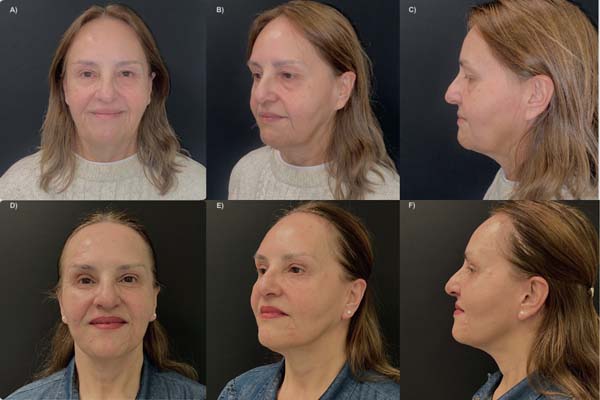

►Fig. 3 shows the oblique and profile views of a 55-year-old female patient before and after 6 months of facial contour improvement surgery.
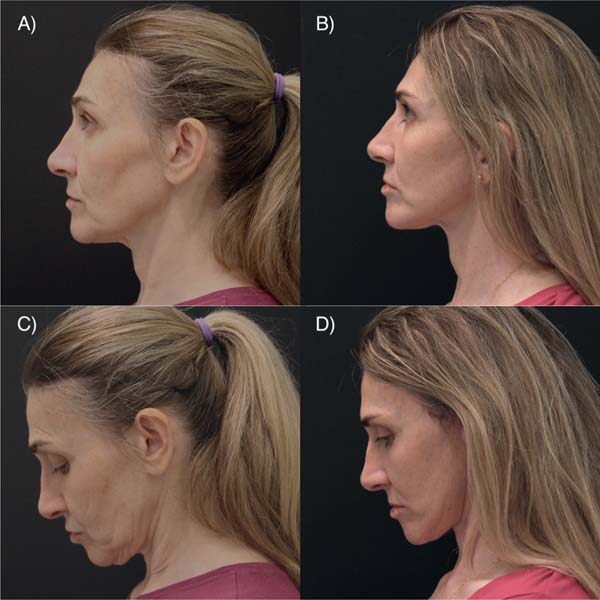
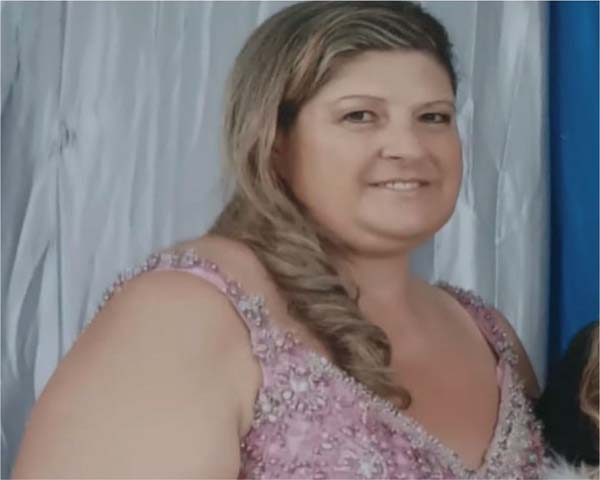
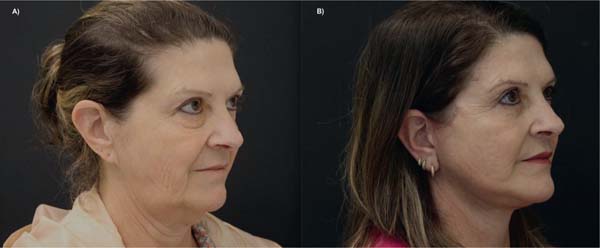
►Fig. 4 presents oblique views of a 61-year-old female patient before a 42 kg weight loss during gastric bypass treatment. ►Fig. 5 shows oblique views of the same patient from ►Fig. 4 before and after 3 months of rejuvenation and facial contour improvement treatment.


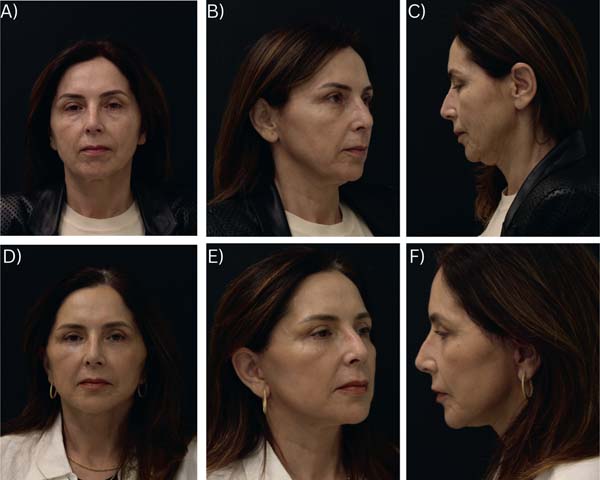
►Fig. 6 presents frontal, profile, and profile with chin flexion views of a 57-year-old female patient before and after 6 months of rejuvenation and facial contour improvement treatment.
There was one case of transient paresis of the marginal mandibular nerve observed on one hemiface. Treatment consisted of the application of two units of botulinum toxin to the contralateral depressor anguli oris muscle and facial motor physiotherapy. Complete and spontaneous resolution occurred within 2 months after surgery. No major complications were observed, such as pulmonary or venous thromboembolism, infections, hypertrophic or keloid scars, wound dehiscence, seromas, or hematomas.
All patients reported satisfaction with the surgical outcome and scar appearance.
Discussion
Symmetry, balanced facial proportions, and contour are considered fundamental components of the perception of beauty and youthfulness.13 Understanding aesthetic proportions and contour is essential. Analogous to the Renaissance concept of three-dimensional artistic painting known as chiaroscuro (light and shade), soft tissue repositioning and volume augmentation of fat pads are the main strategies for improving contour and facial rejuvenation.14,15 Through the described technique and synergistic procedures, it is possible to reposition tissues, as well as address skin laxity, volume loss, and occasional fine static and dynamic wrinkles.
Patients who have undergone massive weight loss surgery generally present with a large amount of redundant skin and soft tissue. Complaints such as a “melted face” and “neck laxity” are prevalent in this population. Patients are particularly dissatisfied with the appearance of the face and neck after massive weight loss because these areas cannot be concealed by clothing. The perception of a facial appearance that does not correspond to their actual age is also a frequent complaint. The surgical goals of facial rejuvenation are to redrape the skin, restore the jawline and neck contour, and harmonize facial contour with the patient’s chronological age and other body regions.8 In this study, we present a feasible strategy to address these concerns.
Patient demands include not only surgical outcomes but also the duration of postoperative recovery. The time during which patients must interrupt their normal activities represents a critical factor in treatment decision-making. The MACS-lift technique used in this series offers the prospect of a procedure with an average duration of approximately 2 hours, performed on an outpatient basis, and with early return to daily activities (7–10 days). Additional advantages include smaller scars compared with traditional techniques, less postoperative edema than deep-plane techniques, and the possibility of performance under local anesthesia with sedation. Despite this technique’s known limitations—particularly regarding cervical treatment—we believe that, when appropriately indicated, this technique can provide satisfactory and natural results with reduced postoperative morbidity, as demonstrated in this series.2,9,15
The diet of patients undergoing weight loss treatment must be monitored by a multidisciplinary team, and preoperative nutritional assessment before facial rejuvenation surgery is essential. In our series, all patients underwent nutritional evaluation through medical history, physical examination by a specialized nutritionist, and laboratory tests (albumin, iron, and ferritin levels).
Effective communication with patients is mandatory, as their postoperative appearance may differ from their pre-bariatric and early life appearence. Expectations must always be aligned during the preoperative consultation. From a practical standpoint, we observed that, after massive weight loss, skin tends to exhibit reduced contractile capacity, which may result in some degree of residual laxity in the late postoperative period. The use of adjunctive skin-tightening technologies is under development and may represent an alternative for optimizing outcomes.
Soft tissue repositioning through facelift procedures remains the cornerstone of facial rejuvenation. However, when appropriately indicated, minor associated procedures tend to enhance results. In our series, procedures such as botulinum toxin injections for dynamic rhytides and brow tail positioning, surgical brow lifting, blepharoplasty, fat grafting, and microneedling with nanofat were indicated to optimize outcomes through synergistic treatment approaches.
One of the most common complications in rhytidoplasty is hematoma formation. Hemostatic nets and fibrin glue are efficient and safe methods for its prevention.16,17 In our practice, these strategies are used in patients at high risk for hematoma. Infiltration with an epinephrine-containing anesthetic solution approximately 10 to 12 minutes before incision helps control diffuse bleeding and facilitates dissection. Several effective infiltration techniques have been described for rhytidoplasty. We believe a key technical aspect is that infiltration should be performed progressively throughout the procedure rather than entirely at the beginning.
Regarding injuries to the marginal mandibular branch of the facial nerve, such injuries may occur after neck liposuction but are rare and usually result from inadvertent subplatysmal liposuction. Transient paresis of the depressor anguli oris muscle, unilateral or bilateral, may occur due to regional edema and will typically resolve spontaneously within a few weeks.18
The main limitations of this study are its retrospective design and limited sample size, resulting in reduced external validity. Additionally, patient-perceived outcomes were not objectively assessed.
Conclusion
In this study, we present an analysis of a strategy for the treatment of facial and cervical aging in patients after massive weight loss. This type of surgery has expanded in scope and case volume worldwide in recent years. As in any surgical specialty, understanding the impact of surgical reconstruction on patients is a crucial aspect in treatment evolution.
REFERENCES
1. Foissac R, Camuzard O, Piereschi S, et al. High-Resolution Magnetic Resonance Imaging of Aging Upper Face Fat Compartments. Plast Reconstr Surg 2017;139(04):829–837. Doi: 10.1097/PRS.0000000000003173
2. Tonnard PL, Verpaele AM, Bensimon RH, editores. Centrofacial Rejuvenation. 1st ed. Nova York: Thieme; 2018 Doi: 10.1055/b-005-143637
3. Zanin EM, Arpini NE, Roth JC, Avalos GV, Duarte DW, Collares MVM. Dermal Matrix Graft Effects on Facial Growth in a Veau-Wardill-Kilner Palatoplasty Model: An Experimental Study in Rats. Cleft Palate Craniofac J 2024;61(05):733–739. Doi: 10.1177/10556656221139674
4. Madalosso CAS, Gurski RR, Callegari-Jacques SM, Navarini D, Mazzini G, Pereira MdS. The Impact of Gastric Bypass on Gastroesophageal Reflux Disease in Morbidly Obese Patients. Ann Surg 2016;263(01):110–116. Doi: 10.1097/SLA.0000000000 001139
5. Navarini D, Madalosso CAS, Tognon AP, Fornari F, Barão FR, Gurski RR. Predictive Factors of Gastroesophageal Reflux Disease in Bariatric Surgery: a Controlled Trial Comparing Sleeve Gastrectomy with Gastric Bypass. Obes Surg 2020;30(04):1360–1367. Doi: 10.1007/s11695-019-04286-5
6. Valente DS, Silva JBd, Mottin CC, et al. Influence of Massive Weight Loss on the Perception of Facial Age: The Facial Age Perceptions Cohort. Plast Reconstr Surg 2018;142(04):481e–488e. Doi: 10.1097/PRS.0000000000004738
7. Tonnard PL, Verpaele AM. Short-Scar Face Lift: Operative Strategies and Techniques. St. Louis: Quality Medical Publishing; 2007
8. Narasimhan K, Ramanadham S, Rohrich RJ. Face lifting in the massive weight loss patient: modifications of our technique for this population. Plast Reconstr Surg 2015;135(02):397–405. Doi: 10.1097/PRS.0000000000000881
9. Tonnard P, Verpaele A. The MACS-lift short scar rhytidectomy. Aesthet Surg J 2007;27(02):188–198. Doi: 10.1016/j.asj.2007.01.008
10. Pelle-Ceravolo M, Angelini M, Silvi E. Treatment of Anterior Neck Aging without a Submental Approach: Lateral Skin-Platysma Displacement, a New and Proven Technique for Platysma Bands and Skin Laxity. Plast Reconstr Surg 2017;139(02):308–321. Doi: 10.1097/PRS.0000000000003030
11. Maximiliano J, Pedron M, Oliveira ACP, et al. Nanofat injector: a low-cost disposable device for standardization and optimization of grafting time. Rev Bras Cir Plast 2021;36(02):203–209. Doi: 10.5935/2177-1235.2021RBCP0068
12. Viterbo F, Auersvald A, O’Daniel TG. Gliding Brow Lift (GBL): A New Concept. Aesthetic Plast Surg 2019;43(06):1536–1546. Doi: 10.1007/s00266-019-01486-3
13. Carvas M, Tonnard P, Verpaele A. Rhinoplasty Combined With Centrofacial Lipofilling to Optimize Facial Proportions. Aesthet Surg J Open Forum 2020;2(03):ojz034. Doi: 10.1093/asjof/ojz034
14. Tonnard PL, Verpaele AM, Ramaut LE, Blondeel PN. Aging of the Upper Lip: Part II. Evidence-Based Rejuvenation of the Upper Lip – A Review of 500 Consecutive Cases. Plast Reconstr Surg 2019;143 (05):1333–1342. Doi: 10.1097/PRS.0000000000005589
15. Rohrich RJ, Agrawal NA, Avashia Y, Savetsky IL. A Novel Algorithm for Defining the Mandibular Border. Plast Reconstr Surg 2022;149(03):429e–432e. Doi: 10.1097/PRS.0000000000008881
16. Rezende ARDR, Rezende KL, Chedid GB, Martins JMP, Collares MVM. A comparison of the efficacy of autologous fibrin glue/platelet-poor plasma versus suction drainage in preventing hematoma and seroma in rhytidectomy: A randomized, doubleblind, controlled study. J Plast Reconstr Aesthet Surg 2021;74(09): 2290–2295. Doi: 10.1016/j.bjps.2020.12.098
17. Auersvald A, Auersvald LA. Hemostatic net in rhytidoplasty: an efficient and safe method for preventing hematoma in 405 consecutive patients. Aesthetic Plast Surg 2014;38(01):1–9. Doi: 10.1007/s00266-013-0202-5
18. Tonnard PL, Verpale AM. The MACS-LIFT Short-Scar Rhytidectomy. St. Louis: Quality Medical Publishing; 2004
1. Professor of Medicine, Universidade de Passo Fundo, Passo Fundo, RS, Brazil
2. Private Practice, Clínica EMZ, Passo Fundo, RS, Brazil
Data Availability Data will be available upon request to the corresponding author.
Financial Support The author declares that he did not receive financial support from agencies in the public, private or non-profit sectors to conduct the present study.
Address for correspondence Eduardo Madalosso Zanin, MD, MsC, Rua Uruguai 1.932, 3o andar, Centro, Passo Fundo, RS, CEP: 99010– 112, Brazil (e-mail: eduardo.zanin@gmail.com).
Article received: September 30, 2025.
Article accepted: January 13, 2026.
Conflict of Interests The author has no conflict of interests to declare.
Editor-in-Chief: Dov Charles Goldenberg.
 Read in Portuguese
 Read in English
 PDF PT
 Print
Print
 Send this article by email
 How to Cite
 Mendeley
 Pocket
 Facebook
 Twitter